TSF JB Policies
TSF Journal of Biology — Journal Policies
Published by TSF Nexus (Pvt) Ltd, Pakistan | EISSN: 3006-0478 | PISSN: 3006-0869
Open Access | CC BY 4.0 | Double-Anonymous Peer Review | DOI via Crossref
✓ COPE Compliant ✓ ICMJE Standards ✓ PMC Ready ✓ Declaration of Helsinki ✓ DOAJ Indexed
1. Aims and Scope
TSF Journal of Biology (EISSN: 3006-0478 | PISSN: 3006-0869) is an international, peer-reviewed, open access scientific journal published by TSF Nexus (Pvt) Ltd, Pakistan. Established in 2023, the journal provides a platform for researchers, scientists, and academics worldwide to disseminate original and significant advances in the biological sciences.
1.1 Mission Statement
The mission of TSF Journal of Biology is to advance scientific knowledge by publishing high-quality, rigorously peer-reviewed research that contributes to understanding the fundamental principles of life. The journal promotes open access, fosters global scientific collaboration, and upholds the highest standards of research integrity and publication ethics.
1.2 Subject Coverage
TSF Journal of Biology publishes original research in all major biological science disciplines including:
- Molecular Biology — genomics, proteomics, epigenetics, cell signalling, CRISPR/gene editing
- Microbiology — bacteriology, virology, mycology, parasitology, antimicrobial resistance, microbiome research
- Biochemistry — enzymology, metabolomics, structural biochemistry, biomarker discovery
- Ecology and Environmental Biology — ecosystem dynamics, biodiversity, climate change biology, environmental toxicology
- Zoology — animal physiology, comparative anatomy, ethology, wildlife biology
- Botany — plant physiology, plant genetics, ethnobotany, plant-microbe interactions, plant pathology
- General Biology — interdisciplinary biological research spanning multiple sub-disciplines
1.3 Article Types Accepted
- Original Research Articles — completed original experimental or observational studies
- Review Articles — comprehensive, authoritative syntheses of current knowledge
- Short Communications — concise reports of preliminary or technically significant findings
- Case Studies — detailed reports of unusual biological phenomena with broader scientific relevance
- Letters to the Editor — brief commentaries on recently published articles
2. Open Access and Article Processing Charges Policy
TSF Journal of Biology is fully open access. All articles are made freely and permanently available online immediately upon publication, without subscription fees, access barriers, or embargo periods.
2.1 Open Access License
All articles are published under the Creative Commons Attribution 4.0 International License (CC BY 4.0). Readers may freely share and adapt published content for any purpose, including commercial use, provided appropriate credit is given.
2.2 Article Processing Charges (APCs)
APCs are charged only upon acceptance following successful peer review. There are no submission fees, peer review fees, or reading fees.
| Author Category | APC | Notes |
| Local Authors (Pakistan) | PKR 8,500/- | Per article, upon acceptance |
| International Authors | USD 100 | Per article, upon acceptance |
2.3 APC Waivers and Discounts
Authors from countries classified as low-income by the World Bank may apply for a full or partial APC waiver. Waiver requests do not influence editorial decisions. Contact the Editorial Office before submission to apply.
2.4 Preprint Policy
TSF Journal of Biology supports preprint posting on recognised servers (bioRxiv, arXiv, medRxiv). Authors must disclose preprint posting at submission. Preprint posting is not considered prior publication.
2.5 Archiving
All published content is archived in the PKP Preservation Network (PKP PN) ensuring long-term accessibility. Authors may self-archive the final published version in institutional repositories at any time after publication under CC BY 4.0.
3. Authorship Policy
TSF Journal of Biology adheres to the authorship criteria defined by the International Committee of Medical Journal Editors (ICMJE). Only individuals meeting all four ICMJE criteria may be listed as authors.
3.1 ICMJE Authorship Criteria
Each author must satisfy ALL four criteria:
- Substantial contributions to conception or design, OR to acquisition, analysis, or interpretation of data
- Drafting the work or revising it critically for important intellectual content
- Final approval of the version to be published
- Agreement to be accountable for all aspects of the work
3.2 Prohibited Authorship Practices
- Ghost authorship — excluding substantial contributors from the author list
- Gift or honorary authorship — including individuals who did not make substantial contributions
- Submitting without knowledge or approval of all listed authors
3.3 CRediT Author Contribution Statement
Authors are strongly encouraged to include a CRediT (Contributor Roles Taxonomy) statement. The 14 roles are: Conceptualisation; Data curation; Formal analysis; Funding acquisition; Investigation; Methodology; Project administration; Resources; Software; Supervision; Validation; Visualisation; Writing — original draft; Writing — review and editing.
3.4 Changes to Authorship After Submission
All post-submission changes to the author list require written approval from ALL listed authors. The Editor-in-Chief must approve all author list changes.
3.5 Artificial Intelligence, Generative AI, and AI-Assisted Technologies
AI tools, large language models (LLMs), chatbots, or generative AI systems may not be listed as authors. Authors who used AI in manuscript preparation must comply with the following:
- Mandatory disclosure: Include a statement in the Methods or Acknowledgements disclosing (a) the AI tool name and version; (b) the specific purpose it was used for; and (c) confirmation that authors have reviewed, verified, and take full responsibility for all AI-generated content.
- AI must not be used to fabricate, falsify, or misrepresent data, results, or references. Authors are fully responsible for manuscript accuracy and integrity.
- AI-generated text must not be presented as the authors' original intellectual contribution without disclosure.
- AI must not be used to generate fictitious citations. All references must be verified before submission.
- Unpublished manuscript content must not be uploaded to AI tools that store or share submitted content, as this compromises peer review confidentiality.
Example AI Disclosure: 'The authors used ChatGPT (OpenAI, GPT-4, 2024) to assist with language editing of an earlier draft. The content was reviewed and verified by all authors, who take full responsibility for the accuracy and integrity of the published work.'
4. Peer Review Policy
TSF Journal of Biology operates a rigorous double-anonymous peer review process. Both author and reviewer identities remain confidential throughout, ensuring manuscripts are evaluated solely on scientific merit.
4.1 Initial Editorial Assessment (Desk Review)
All manuscripts undergo initial assessment by the Editor-in-Chief or Section Editor before external review. Desk rejection reasons include: out of scope; below minimum scientific quality; non-compliance with ethical requirements; serious language deficiencies. Authors notified within 10 working days.
4.2 External Peer Review
Manuscripts are sent to a minimum of two independent expert reviewers. Reviewers evaluate: originality and significance; soundness of methodology; accuracy of data and statistical analyses; quality of presentation; completeness of references; and ethical compliance. Target: first decision within 4 weeks of submission.
4.3 Reviewer Responsibilities
- Respond to the invitation within five (5) working days
- Declare conflicts of interest before accepting; decline if conflicts exist
- Maintain strict confidentiality throughout the review process
- Submit a thorough, constructive, objective evaluation within 21 calendar days
- Not upload manuscript content to AI tools that store or share submitted content
- Alert the Editor-in-Chief to suspected ethical violations
4.4 Editorial Decisions
- Accept — accepted in current form
- Minor Revision — minor amendments required before acceptance
- Major Revision — substantial revision required; further review after revision
- Reject — not suitable for publication
5. Plagiarism and Research Integrity Policy
TSF Journal of Biology follows COPE guidelines on research misconduct. All manuscripts are screened using plagiarism detection software before peer review.
5.1 Forms of Plagiarism
- Verbatim copying without quotation marks and citation
- Paraphrasing without attribution
- Reproducing figures, tables, or data without permission and citation
- Self-plagiarism — reproducing previously published work without disclosure
- Duplicate submission or duplicate publication
- Salami slicing — inappropriate fragmentation of a single study into multiple publications
5.2 Data Fabrication and Falsification
Data fabrication, falsification, and inappropriate image manipulation are strictly prohibited. Authors must retain original research data for at least five years after publication and make it available for inspection upon reasonable request.
5.3 Handling Suspected Misconduct
Actions may include: rejection without review; retraction; notification of the author's institution; and/or notification of funding agencies. All investigations are conducted confidentially and impartially in accordance with COPE guidelines.
6. Conflict of Interest / Competing Interest Policy
Full and transparent disclosure of any financial, professional, or personal relationships that could influence the conduct or reporting of research, or the objectivity of editorial processes, is required of all authors, editors, and reviewers.
6.1 Author Disclosure Requirements
- Financial relationships — employment, consultancies, stock ownership, honoraria, patents, and research funding from interested parties
- Personal relationships — relationships with editors or reviewers that could affect objectivity
- Non-financial interests — academic competition, beliefs, or other relationships affecting reporting
Declaration: Where no conflicts exist, authors must state: 'The authors declare no conflicts of interest.'
6.2 Editor and Reviewer Disclosure
Editors with conflicts must recuse themselves entirely. Reviewers with conflicts must decline the invitation. Conflicts include recent collaboration within three years, same institutional affiliation, personal relationships, financial interests, or academic competition.
7. Data Availability and Sharing Policy
All manuscripts must include a Data Availability Statement clearly indicating whether supporting data are publicly available and where they can be accessed. TSF Journal of Biology endorses FAIR data principles (Findable, Accessible, Interoperable, Reusable). Authors are encouraged to deposit data in recognised repositories (NCBI GEO, SRA, GenBank, Dryad, Zenodo, Figshare). Data sharing exceptions (ethical/legal restrictions, confidentiality) must be clearly explained.
8. Copyright and Licensing Policy
All articles are published under CC BY 4.0. Authors retain copyright and grant TSF Journal of Biology a non-exclusive license to publish, distribute, and archive the article. Authors may self-archive the final published version in institutional repositories at any time after publication — no embargo applies. Authors are responsible for obtaining permission for any third-party content included in their manuscript.
9. Publication Ethics and Research Misconduct Policy
TSF Journal of Biology is a follower of COPE guidelines. Authors must: submit only original, unpublished work; accurately report all methods and results; correctly cite all sources; disclose conflicts; and obtain all required ethical approvals. Editors must make objective decisions, maintain confidentiality, manage conflicts, and investigate all credible misconduct allegations. All investigations are conducted confidentially and impartially with authors given opportunity to respond.
10. Advertising and Sponsorship Policy
Advertising, sponsorship, and commercial relationships have no influence on editorial decisions at TSF Journal of Biology. All advertising content is clearly identified and distinguished from editorial content. Advertisers receive no preferential treatment in peer review. TSF Journal of Biology does not publish advertiser-influenced editorial content. Any sponsored supplements must undergo the same peer review process as regular submissions, and sponsors have no editorial control over content.
11. Journal Ownership and Management Policy
TSF Journal of Biology is owned and published by TSF Nexus (Pvt) Ltd, a private limited company registered in Pakistan. The Editorial Board exercises full and independent editorial authority over all decisions regarding manuscript acceptance, content, and publication. The publisher does not intervene in editorial decisions. The journal is funded primarily through APCs (PKR 8,500/- local / USD 100 international). There are no subscriptions, reading fees, or undisclosed revenue streams. The Editorial Board composition is publicly disclosed on the journal website.
12. Accessibility Policy
TSF Journal of Biology publishes all articles in PDF and HTML formats. HTML format is more accessible to screen readers and assistive technologies. As a fully open access journal, all articles are available without subscription or access barriers. Authors are encouraged to provide alt text for figures, use accessible colour schemes, and submit supplementary data in accessible formats. The journal publishes in English and authors are encouraged to use clear, jargon-free language.
13. Author Appeals and Complaints Policy
13.1 Grounds for Appeal
- Decision based on factual error or misunderstanding of the research
- Peer review demonstrably unfair, biased, or inadequate
- Evidence of undisclosed reviewer conflict of interest materially affecting the outcome
- Decision made in violation of the journal's published policies
13.2 Process
Appeals must be submitted in writing to the Editor-in-Chief within 21 calendar days of the editorial decision, with specific grounds and a detailed scientific rebuttal. Final decisions communicated within 30 working days. Unresolved complaints may be escalated to COPE.
14. Human Rights and Research Ethics Policy
Important: Manuscripts reporting human subjects research without evidence of prior ethical approval will be desk-rejected without peer review.
14.1 Ethical Approval
All research involving human participants must have prior approval from a recognised IRB, Ethics Committee, or equivalent authority. Authors must state in the manuscript: the committee name; approval number; date; and confirmation of compliance with the approved protocol.
14.2 Declaration of Helsinki
All human subjects research must comply with the World Medical Association Declaration of Helsinki (current revision), including: respect for participant autonomy; protection of health, dignity, and privacy; primacy of participant welfare; and independent ethical review.
14.3 Privacy, Confidentiality, and Vulnerable Populations
Participants must not be identifiable unless written consent has been obtained. Research involving minors requires parental consent and, where appropriate, child assent. Research on vulnerable populations (cognitively impaired, prisoners, pregnant women) requires additional protective measures clearly described in the manuscript.
14.4 Clinical Trial Registration
All clinical trials must be prospectively registered in a WHO ICTRP-recognised registry. The registration number and registry name must be stated in the manuscript.
Example Ethics Statement: 'This study was conducted in accordance with the Declaration of Helsinki and approved by the Ethics Committee of [Institution] (Approval No. [Number], [Date]). Written informed consent was obtained from all participants prior to enrolment.'
15. Animal Rights and Welfare Policy
Important: Manuscripts reporting animal research without evidence of prior ethical approval will be desk-rejected without peer review.
15.1 Ethical Approval
All animal research must have prior approval from an IACUC, Animal Ethics Committee, or equivalent regulatory authority. The committee name, approval number, date, and compliance statement must be included in the Methods section.
15.2 The 3Rs Principles
- Replacement — alternatives to animal use must have been considered. Species choice must be scientifically justified.
- Reduction — minimum number of animals for statistically valid results. Sample size justification (including power analysis) must be provided.
- Refinement — measures to minimise pain, suffering, and distress, including anaesthesia, analgesia, and humane endpoints, must be described.
15.3 ARRIVE Guidelines
All in vivo animal research manuscripts must comply with ARRIVE 2.0 guidelines. The ARRIVE 2.0 checklist must be submitted alongside the manuscript. Non-human primate research requires the highest level of ethical justification. Research on CITES-listed species requires appropriate regulatory permits.
16. Informed Consent Policy
16.1 Standards
- Voluntariness — free from coercion; participants informed of right to withdraw
- Comprehension — plain language appropriate to participant's background
- Disclosure — complete information on purpose, procedures, risks, benefits, and confidentiality
- Documentation — written consent form signed and retained by the investigator
16.2 Consent for Publication and Waiver
Where identifiable participant information is published, explicit written consent authorising publication is required. For minors under 18, parental consent is mandatory; child assent is also required where developmentally appropriate. Where an ethics committee has granted a consent waiver, the committee name, waiver number, and justification must be stated.
Example Statement: 'Written informed consent was obtained from all participants. The study was approved by the Ethics Committee of [Institution] (Approval No. [Number], [Date]) and conducted in accordance with the Declaration of Helsinki.'
17. Article Correction Policy
17.1 Types of Corrections
- Erratum — errors introduced by the journal during production/typesetting
- Corrigendum — errors made by authors not identified during peer review or identified post-publication
- Author Information Corrections — amendments to names, affiliations, ORCIDs, or author order
17.2 Process and Publication
Authors who identify errors must contact the Editorial Office with: the full citation and DOI; a description of each error and location; the proposed correction; and written confirmation of all co-authors' agreement. Approved corrections are published as formal Correction Notices assigned their own DOI, permanently linked to the original article, and indexed in all relevant databases. Target: 30 working days from approval. Corrections are NOT issued where errors fundamentally affect conclusions — retraction may be appropriate in such cases.
18. Retraction and Expression of Concern Policy
18.1 Grounds for Retraction
- Research misconduct — fabrication, falsification, image manipulation, plagiarism, duplicate publication
- Significant honest error — errors fundamentally undermining validity or conclusions
- Ethical violations — research without ethical approval or informed consent
- Legal concerns — copyright infringement, defamatory content, court order
18.2 Retraction Process
The Editorial Office acknowledges concerns within 5 working days, notifies the corresponding author allowing 21 days to respond, and investigates confidentially and impartially in accordance with COPE guidelines. Authors may appeal within 21 days of the retraction decision.
18.3 Retraction Notices and Expressions of Concern
Retraction Notices are published as separate citable documents with their own DOI, permanently linked to the retracted article. The original is marked 'RETRACTED' with the date and reasons. Notices are submitted to CrossRef, PubMed, DOAJ, and all relevant databases. An Expression of Concern may be published during ongoing investigations, updated or replaced when investigations conclude.
19. Post-Publication Changes Policy
Published articles form a permanent part of the scientific record. All post-publication changes must be transparently documented and communicated via permanent notices linked to the affected article. Guiding principles: Preservation (original version always retained); Transparency (all changes dated and documented); Proportionality (actions proportionate to the issue); COPE compliance. Permitted changes include: corrections, retractions, expressions of concern, author information updates, and funding/conflict corrections. Changes not permitted: adding new data not in the accepted manuscript; removing content except through retraction; changes for competitive advantage; third-party changes without scientific justification. All content is archived in the PKP Preservation Network. Requests must be submitted to the Editorial Office and acknowledged within 5 working days, processed within 30 working days.
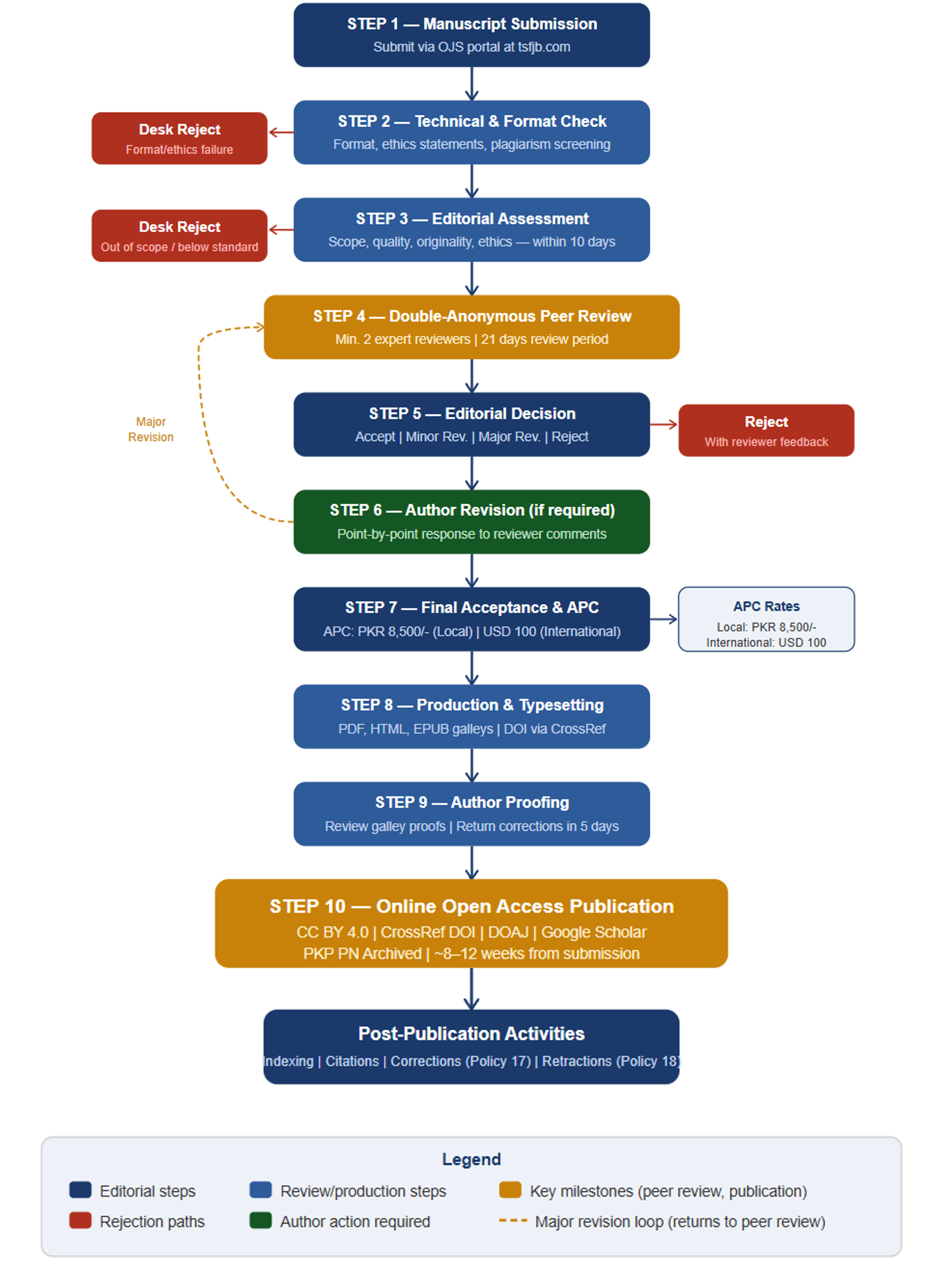
20. Publication Process Flowchart
Target: First decision ~4 weeks | Submission to publication ~8–12 weeks
TSF Journal of Biology — Complete Policies Document v3.0 | April 2026
TSF Nexus (Pvt) Ltd, Pakistan | tsfjb.com | EISSN: 3006-0478 | PISSN: 3006-0869
COPE | ICMJE | PMC | Declaration of Helsinki | APC: PKR 8,500/- (Local) / USD 100 (International)