Bioinformatics-driven discovery of key Biomarkers and Therapeutic Targets in Hepatocellular Carcinoma
Key Biomarkers and Therapeutic Targets in Hepatocellular Carcinoma
DOI:
https://doi.org/10.69547/NS.41.02Keywords:
Biomarkers, Hepatocellular Carcinoma, Bioinformatics, Therapeutic Targets, CancerAbstract
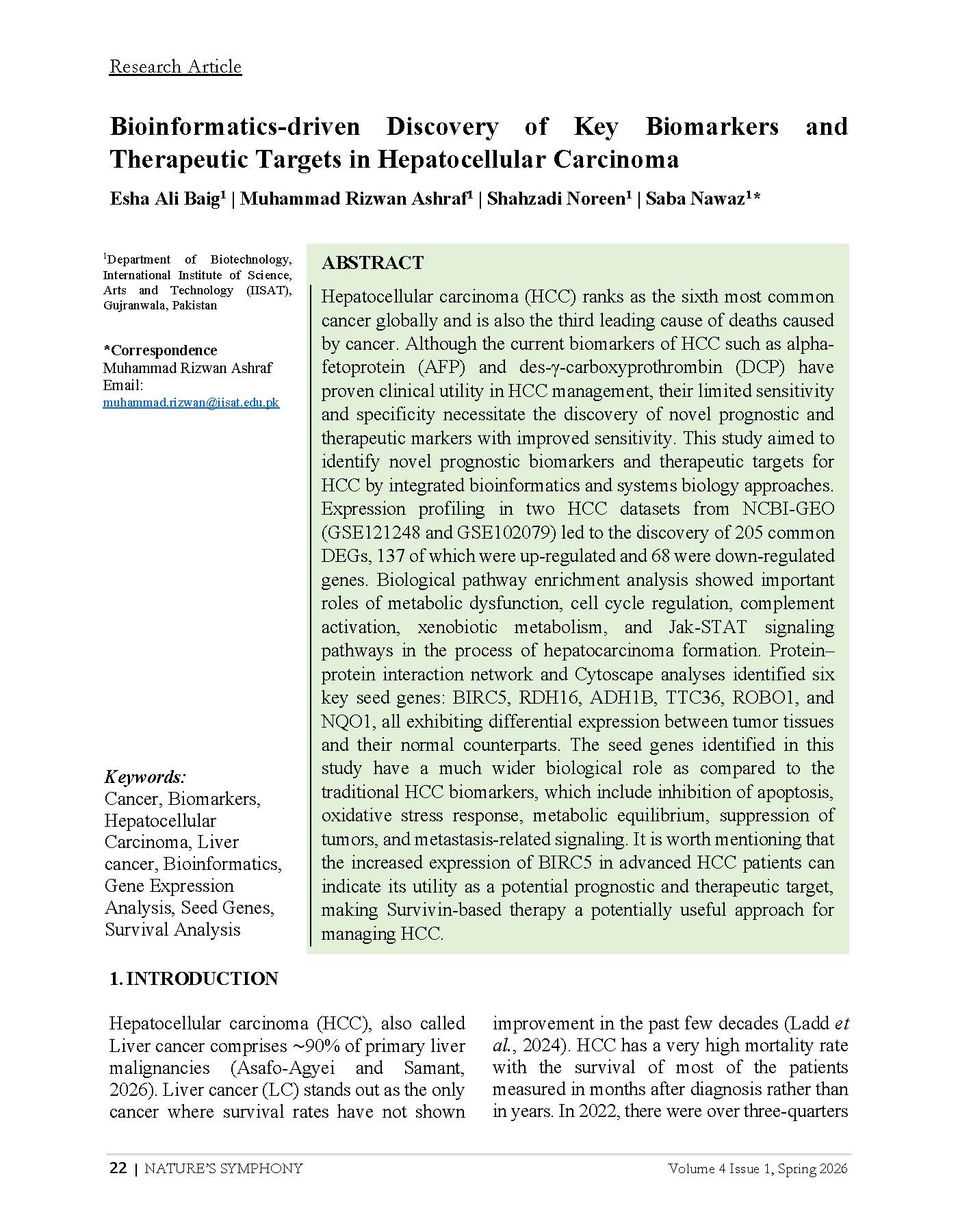
Hepatocellular carcinoma (HCC) ranks as the sixth most common cancer globally and is also the third leading cause of deaths caused by cancer. Although the current biomarkers of HCC such as alpha-fetoprotein (AFP) and des-γ-carboxyprothrombin (DCP) have proven clinical utility in HCC management, their limited sensitivity and specificity necessitate the discovery of novel prognostic and therapeutic markers with improved sensitivity. This study aimed to identify novel prognostic biomarkers and therapeutic targets for HCC by integrated bioinformatics and systems biology approaches. Expression profiling in two HCC datasets from NCBI-GEO (GSE121248 and GSE102079) led to the discovery of 205 common DEGs, 137 of which were up-regulated and 68 were down-regulated genes. Biological pathway enrichment analysis showed important roles of metabolic dysfunction, cell cycle regulation, complement activation, xenobiotic metabolism, and Jak-STAT signaling pathways in the process of hepatocarcinoma formation. Protein–protein interaction network and Cytoscape analyses identified six key seed genes: BIRC5, RDH16, ADH1B, TTC36, ROBO1, and NQO1, all exhibiting differential expression between tumor tissues and their normal counterparts. The seed genes identified in this study have a much wider biological role as compared to the traditional HCC biomarkers, which include inhibition of apoptosis, oxidative stress response, metabolic equilibrium, suppression of tumors, and metastasis-related signaling. It is worth mentioning that the increased expression of BIRC5 in advanced HCC patients can indicate its utility as a potential prognostic and therapeutic target, making Survivin-based therapy a potentially useful approach for managing HCC.
Downloads
Published
How to Cite
Issue
Section
License
Copyright (c) 2026 Esha Ali Baig, Muhammad Rizwan Ashraf, Shahzadi Noreen, Saba Nawaz

This work is licensed under a Creative Commons Attribution 4.0 International License.
This journal is licensed under a Creative Commons Attribution 4.0 International License (CC BY 4.0), where copyright for articles remains with the authors.
This journal utilizes the Public Knowledge Project’s Preservation Network (PKP PN) and LOCKSS system to ensure long‑term digital preservation of all published content.
This journal provides immediate open access to its content on the principle that making research freely available to the public supports a greater global exchange of knowledge.
