Effect of Thermal Oxidation Parameters on Morphological Properties of Thermal Oxide Coatings on Ti6Al4V Titanium Alloy
Thermal Oxidation Effects on Ti6Al4V Coatings
DOI:
https://doi.org/10.69547/NS.31.05Keywords:
Thermal oxidation coating, Ti6Al4V alloy, Morphological properties, Coating thickness, Titanium alloysAbstract
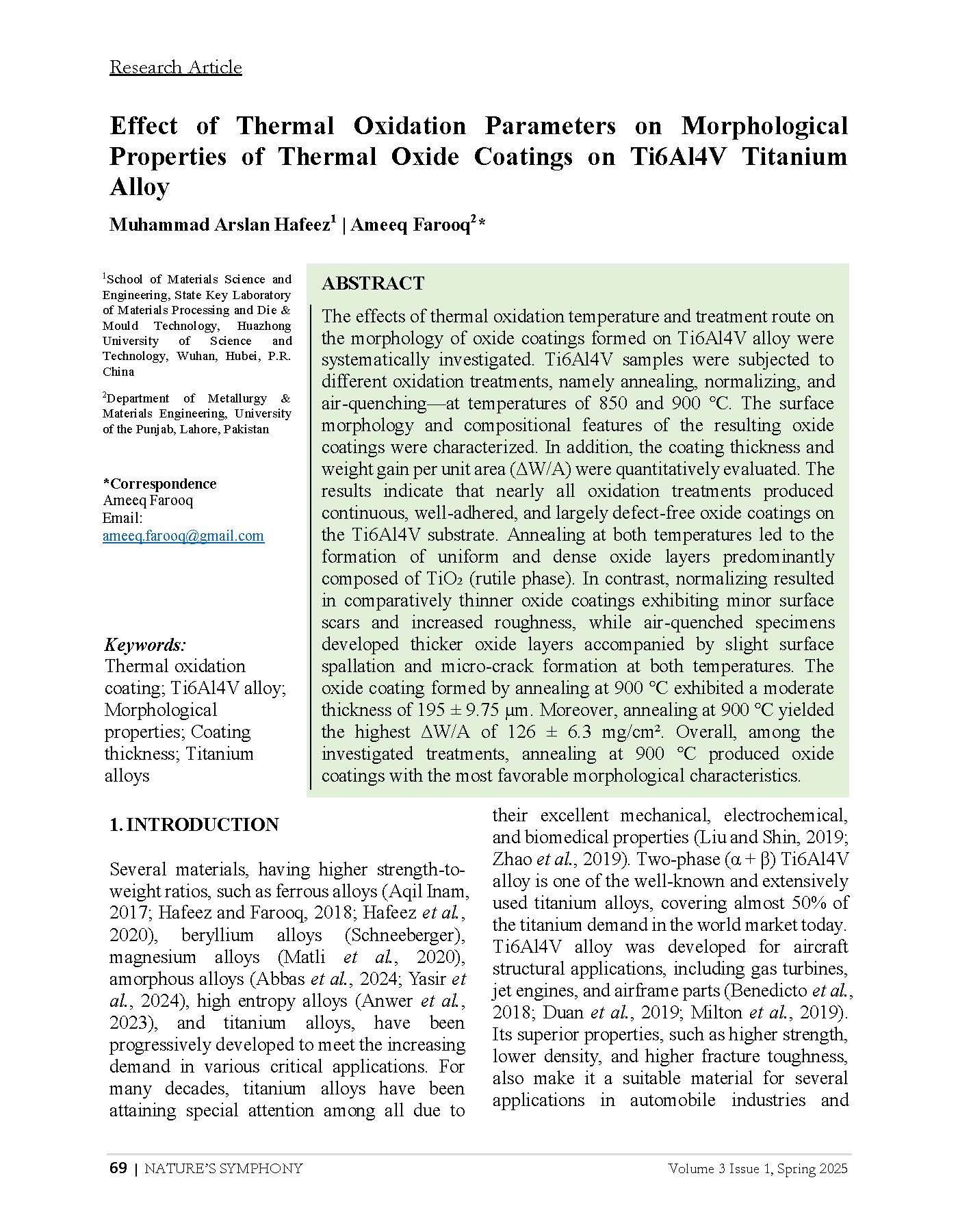
The effects of thermal oxidation temperature and treatment route on the morphology of oxide coatings formed on Ti6Al4V alloy were systematically investigated. Ti6Al4V samples were subjected to different oxidation treatments, namely annealing, normalizing, and air-quenching—at temperatures of 850 and 900 ℃. The surface morphology and compositional features of the resulting oxide coatings were characterized. In addition, the coating thickness and weight gain per unit area (ΔW/A) were quantitatively evaluated. The results indicate that nearly all oxidation treatments produced continuous, well-adhered, and largely defect-free oxide coatings on the Ti6Al4V substrate. Annealing at both temperatures led to the formation of uniform and dense oxide layers predominantly composed of TiO₂ (rutile phase). In contrast, normalizing resulted in comparatively thinner oxide coatings exhibiting minor surface scars and increased roughness, while air-quenched specimens developed thicker oxide layers accompanied by slight surface spallation and micro-crack formation at both temperatures. The oxide coating formed by annealing at 900 ℃ exhibited a moderate thickness of 195 ± 9.75 µm. Moreover, annealing at 900 ℃ yielded the highest ΔW/A of 126 ± 6.3 mg/cm². Overall, among the investigated treatments, annealing at 900 ℃ produced oxide coatings with the most favorable morphological characteristics.
Additional Files
Published
How to Cite
Issue
Section
License
Copyright (c) 2025 Dr. Ameeq Farooq, Muhammad Arslan

This work is licensed under a Creative Commons Attribution 4.0 International License.
This journal is licensed under a Creative Commons Attribution 4.0 International License (CC BY 4.0), where copyright for articles remains with the authors.
This journal utilizes the Public Knowledge Project’s Preservation Network (PKP PN) and LOCKSS system to ensure long‑term digital preservation of all published content.
This journal provides immediate open access to its content on the principle that making research freely available to the public supports a greater global exchange of knowledge.
