First Principles Simulation of Ferromagnetic A2MnCl6 (A = K, Rb, Cs) Double Perovskites for Energy Efficient Spintronic Applications
First Principles Simulation of Ferromagnetic A2MnCl6
DOI:
https://doi.org/10.69547/NS.21.02Keywords:
Ferromagnetic semiconductors, DFT analysis, Magnetic moments, Figure of meritAbstract
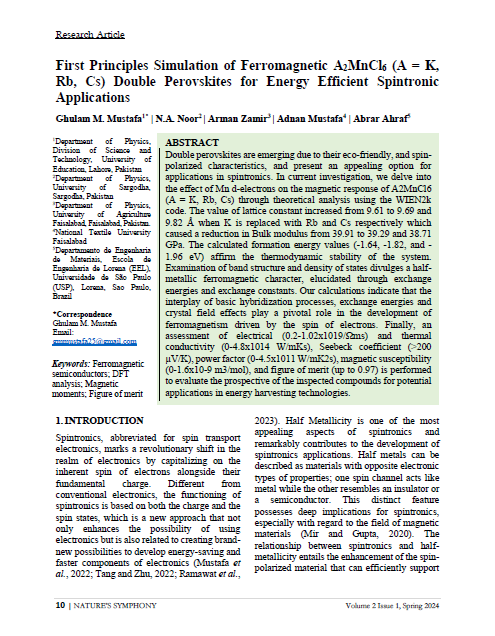
Double perovskites are emerging due to their eco-friendly, and spin-polarized characteristics, and present an appealing option for applications in spintronics. In current investigation, we delve into the effect of Mn d-electrons on the magnetic response of A2MnCl6 (A = K, Rb, Cs) through theoretical analysis using the WIEN2k code. The value of lattice constant increased from 9.61 to 9.69 and 9.82 Å when K is replaced with Rb and Cs respectively which caused a reduction in Bulk modulus from 39.91 to 39.29 and 38.71 GPa. The calculated formation energy values (-1.64, -1.82, and -1.96 eV) affirm the thermodynamic stability of the system. Examination of band structure and density of states divulges a half-metallic ferromagnetic character, elucidated through exchange energies and exchange constants. Our calculations indicate that the interplay of basic hybridization processes, exchange energies and crystal field effects play a pivotal role in the development of ferromagnetism driven by the spin of electrons. Finally, an assessment of electrical (0.2-1.02x10¹⁹/Ωms) and thermal conductivity (0-4.8x10¹⁴ W/mKs), Seebeck coefficient (>200 µV/K), power factor (0-4.5x10¹¹ W/mK2s), magnetic susceptibility (0-1.6x10⁻⁹ m3/mol), and figure of merit (up to 0.97) is performed to evaluate the prospective of the inspected compounds for potential applications in energy harvesting technologies.
Downloads
Published
How to Cite
Issue
Section
License
Copyright (c) 2024 Ghulam M. Mustafa, N.A. Noor, Arman Zamir, Adnan Mustafa, Abrar Ahraf

This work is licensed under a Creative Commons Attribution 4.0 International License.
This journal is licensed under a Creative Commons Attribution 4.0 International License (CC BY 4.0), where copyright for articles remains with the authors.
This journal utilizes the Public Knowledge Project’s Preservation Network (PKP PN) and LOCKSS system to ensure long‑term digital preservation of all published content.
This journal provides immediate open access to its content on the principle that making research freely available to the public supports a greater global exchange of knowledge.
