Impact of Work Overload on Dietary Habits, Sleep Quality, and Well-Being Among University Employees in Lahore, Pakistan
Muhammad Jawad1 | Ammara Arshad1* | Urooj Afzal1 | Muhammad Hassan1 | Sadia Iqbal1 | Rimsha Riaz1 | Tanzeel Fatima1
1Department of Nutrition and Dietetics, School of Health Sciences, University of Management and Technology Lahore, Pakistan
*Correspondence
Nazia Jamil
Email: nazia.mmg@pu.edu.pk
|
ABSTRACT The persistent issue of work overload (WO) among university employees, particularly teaching faculty, may adversely impact their dietary choices, physical and mental well-being. This study aimed to analyze the impact of WO on the dietary habits (DH), sleep quality (SQ) and psychophysical well-being (PSYPHY) of the university employees. In this cross-sectional study, data was collected from 121 university professionals in different private sector universities in Pakistan to access WO, SQ, DH and PSYPHY via structured questionnaires. Study findings concluded that there was a significant strong negative association of WO with DH, SQ and PSYPHY of participants. Hence, increase in WO has decreased the (healthy) DH, SQ and PSYPHY of university employees.
|
The amount of work a person has to do is termed as workload. On the other hand, when an individual has many tasks to perform and gets overburdened then it is termed as WO [1]. A high-quality competent workforce can perform the tasks for any organization efficiently. It consists of high specificity of skills, knowledge and attitude in addition to its application in job-based performance. WO is a prevailing issue in today’s fast paced working environment. Its impacts on employees’ well-being have gained significant attention from researchers and various organizations worldwide [2]. Current research study highlighted the impact of WO on employees’ eating pattern, SQ and PSYPHY, especially in the context of private sector universities in Pakistan.
Higher education institutes, including universities, in Pakistan have become increasingly competitive, directing towards academic excellence and financial sustainability. Consequently, faculty and staff working in these academic intuitions often face demanding workload to achieve their goals. Meeting tight deadlines, working for long hours, and meeting high expectations can lead to physical and psychological stress and in the long run can affect health status of working personnel [3, 4].
Workplace obligations (WO) can significantly influence the dietary habits (DH) of working individuals. Long hours at work and the pressure to meet deadlines often lead to irregular eating patterns. Many individuals may skip meals due to time constraints or stress, which can negatively impact their overall health. [5]. In such scenarios, the convenience of fast food becomes an attractive option, as preparing healthy meals is often impractical. Additionally, workplace stress is closely associated with unhealthy eating behaviors, which can disrupt gut health, alter taste preferences, and interfere with hunger regulation mechanisms.[6].
A balanced diet provides the nutrients your body needs each day to stay healthy and well-nourished. It keeps your body’s systems functioning smoothly and gives you the energy to power through daily tasks. When your nutritional needs are met, your brain works better, and you feel more active and energetic overall. [7]. People having good DH can actually enjoy long healthy life and keep many diseases at bay. There are many factors that actually disturb eating habits including time management, access to food or food availability, stress, food choices, diseases and WOO. All these factors change a person’s approach to eat a well balance diet and may disturb his overall eating pattern [8].
Sleep quality (SQ) refers to the ability to sleep peacefully for the recommended duration, which varies by age. For adults, 7–8 uninterrupted hours of sleep per night is typically advised. Good sleep quality involves minimal disturbances, such as waking no more than once during the night, allowing the body to rest and recharge fully. Peaceful sleep is essential for restoring energy and enabling the body to function optimally the next day. [9]. However, various factors can disrupt sleep patterns, particularly for working individuals. Stress, environmental conditions, irregular eating habits, health issues, and workplace obligations (WO) can all interfere with restful sleep. These disruptions make it difficult to achieve the deep, restorative sleep needed for overall well-being.[10].
Employees under the influence of stress might not be able to meet their work expectations due to psychological and physical burnouts. Excessive work stress may result in poor job performance by employees [11]. Heavy and excessive workload before bed has an association with non-restorative sleep. Males and females have different responses towards perceived mental intensity in relation to SQ characteristics. Females having high mental intensity might suffer from the symptoms of insomnia [12].
A heavy workload can take a serious toll on the mental health and well-being of working individuals. Even though people are aware of how overwork can negatively affect their health, many still find themselves overwhelmed with tasks. This often happens when they lack the resources or support needed to handle their assigned responsibilities effectively [13]. Workplace obligations demands can be overwhelming and may lead to stress, anxiety, or emotional struggles, especially for academic professionals. Balancing multiple roles responsibilities and managing a heavy workload often impacts their mental health, making it challenging to maintain overall well-being. [14].
Workplace obligations (WO) can also be a significant risk factor for physical health issues. Individuals with demanding office or organizational workloads often report symptoms such as constipation, diarrhea, or other signs of physical health problems. Many employees experiencing heavy workloads self-report various health concerns, highlighting the impact of work-related stress on overall well-being. aces [15].
Research design used in this study was correlational and descriptive cross-sectional in which the relationship between different variables (WO, DH, SQ and PSYPHY) has been observed. The reason behind choosing cross-sectional study design was to assess the impacts of exposure variable on outcome variables. Simple random sampling technique was used to collect data.
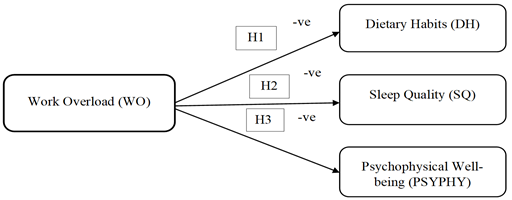
Figure 1. Theoretical framework that includes the relationship among study variables. The independent variable includes work overload (WO), and depended variables include dietary habits (DH), sleep quality (SQ) and psychophysical well-being (PSYPHY). This model suggests that WO significantly impact DH, SQ, and PSYPHY.
This study was carried out from February to April 2023, involving 121 university professionals from four private-sector universities in Pakistan. To be eligible, participants needed to have been employed at their respective universities for at least one year prior to the study. The sample size represented 10% of the total study population, and data collection took place over a period extending from February to June 2023. We prioritized quality over quantity by selecting a 10% sample size that was representative of the study population. This decision was influenced by several factors, including limited resources, a high number of refusals from potential participants, and the short timeframe for completing the project. While a larger sample size could improve the generalizability of the results, the findings from this representative sample provide valuable insights and can serve as a foundation for future large-scale studies and targeted interventions.
WO (occurs when job requirements are more than the time and resources) [1] was taken as independent variable, while on the other hand DH (preferred food choices in daily life) [7], SQ (the measure of self-satisfaction with each aspect of sleep experience) [9] and PSYPHY (positive well-being condition of mind and body) [11] have been analyzed as dependent variables. All study variables are quantitative. WO of study population was measured by using a structured questionnaire by Reilly [16], independent variables were measured by using structured questionnaires as DH were analyzed by method used by Alzahrani et al. [17], SQ was assessed by following Kato [18], and PSYPHY was analyzed by connecting two questionnaires as mental health by Valdehita et al. [19] and physical health by Schat et al. [20]. There were no potential sources of bias reported.
Current research study has been approved by (Reference number:RE-085-2023) Office of Research Innovation &Commercialization (ORIC) & Research Ethics & Support Committee (RESC), University of Management and Technology (UMT), Lahore, Punjab, Pakistan.
All the participants had duly signed the written consent form before filling the study questionnaires for data collection.
Data analysis has been performed through IBM SPSS Statistics software version 25. Descriptive tests are applied to analyze the demographic data. Data normality assessment, correlational statistics, reliability analysis (internal consistency via Cronbach’s alpha), linear regression and multi-collinearity statistics are performed in this research study. To check the impact of exposure variable on outcome variables, linear regression was applied on each outcome variables one after another to test the relationship among the variables. Correlation test was applied on the variables to see the nature of association among the studied variables.
Demographic statistics highlighted the descriptive statistical information and showed the frequencies and percentages of demographic items which have been recorded during the study. Figure 2 showed that among 121 of the total respondents, 51.24% were males (n = 62) and 48.76% were females participants (n = 59). It also depicted the marital status of respondents in which 37.19% (n = 45) were unmarried and 62.81% (n = 76) were married. In addition, it represented living arrangement in which 12.40% (n = 15) respondents were living alone and 87.60% (n = 106) were living with their families. Annual course load of faculty members has been mentioned in Figure 3 which showed that most of the respondents have five (24.8%) and six (28.1%) courses to teach annually. Figure 4 presented the working hours of respondents per week in which most of the study participants were working 28 hours (23.1%), 30 hours (15.7%) and 35 hours (19.8%) per week.
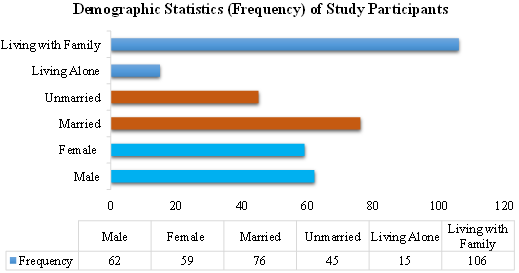
Figure 2. Frequencies of demographic statistics (i.e. gender, marital status and living arrangement) of university professionals at private sector universities of Lahore, Pakistan
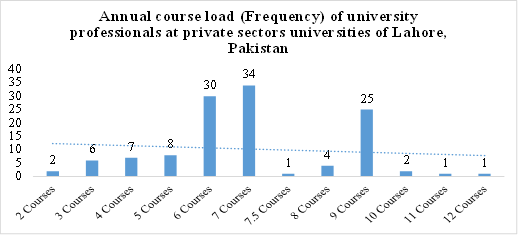
Figure 3. Frequencies of annual course load of university professionals at private sector universities of Lahore, Pakistan (N = 121)
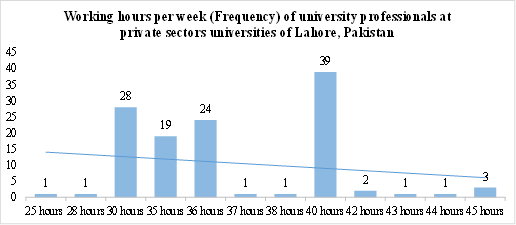
Figure 4. Frequencies of working hours per week of university professionals at private sector universities of Lahore, Pakistan (N = 121)
Table 1. Data Analysis Assumptions and Reliability Measure
|
Variable |
Skewness |
Kurtosis |
Tolerance |
VIF |
Cronbach Alpha |
|
WO |
-0.234 |
-0.513 |
0.611 |
1.637 |
0.818 |
|
DH |
0.926 |
0.416 |
0.914 |
1.094 |
0.786 |
|
SQ |
-0.064 |
-0.343 |
0.692 |
1.445 |
0.859 |
|
MH |
0.121 |
0.390 |
0.730 |
1.369 |
0.909 |
|
PH |
0.559 |
0.980 |
0.651 |
1.537 |
0.856 |
|
PSYPHY |
0.055 |
0.358 |
0.580 |
1.725 |
0.916 |
WO: work overload, DH: dietary habits, SQ: sleep quality, MH: mental health, PH: physical health, PSYPHY: psychophysical well-being
Following are the basic assumptions of carrying out group differences or regression analysis.
Normality to apply parametric tests was measured through skewness and kurtosis hose values were not beyond the criteria i.e., ±1 (Table 1).
Table 1 showed that there was no multicollinearity among (independent & dependent) variables indicating a linear relationship. VIF values of WO, DH, SQ and PSYPHY were <5, which indicates no collinearity among the studied variables.
Scatterplot was used to check this assumption, Figure 6 showed that data was randomly scattered around zero, indicating that data was unbiased and homoscedastic.
Table 1 depicted that our model adequately met the acceptable values for Cronbach’s alpha i.e., > 0.7 for confirmatory purposes. Value of Cronbach alpha was 0.818 for WO, 0.786 for DH, 0.859 for SQ, 0.909 for MH and 0.856 for PH, and .916 for PSYPHY. It showed that there was an internal consistency between each variable.
Mean and Standard Deviation for the study variables provide (Table 2) useful clues on how respondents replied to the details in the questionnaires and how useful the scales corresponding entries are to draw on the related theories.
Table 2 showed that there is negative correlation of WO with DH, SQ and PSYPHY of study respondents. It demonstrated an increase in WO would result in decreased DH, SQ and PSYPHY among the studied population.
This study used direct effect (causal) hypotheses which were tested by utilizing linear regression technique in IBM SPSS v.27.
Table 2. Central Tendency and Correlations
|
Variable |
N |
Mean |
Std. Dev. |
WO |
DH |
SQ |
MH |
PH |
PSYPHY |
|
WO |
121 |
3.19 |
0.78 |
1 |
|||||
|
DH |
121 |
3.29 |
0.60 |
-.281** |
1 |
||||
|
SQ |
121 |
2.88 |
0.75 |
-.448** |
.199* |
1 |
|||
|
MH |
121 |
3.39 |
0.55 |
-.443** |
0.11 |
.407** |
1 |
||
|
PH |
121 |
2.67 |
0.66 |
-.518** |
.194* |
.459** |
.395** |
1 |
|
|
PSYPHY |
121 |
3.03 |
0.51 |
-.579** |
.185* |
.521** |
.799** |
.868** |
1 |
**: correlation is significant at 0.01, *: correlation is significant at 0.05, WO: work overload, DH: dietary habits, SQ: sleep quality, MH: mental health, PH: physical health, PSYPHY: psychophysical well-being
Table 3. Regression Analysis of WO with DH, SQ and PSYPHY
|
Outcome |
Estimate |
Std. Error |
P |
R Square |
F |
df |
Sig. |
|
DH |
-0.214 |
0.067 |
0.000 |
0.079 |
10.202 |
1, 119 |
0.002 |
|
SQ |
-0.426 |
0.078 |
0.000 |
0.201 |
29.862 |
1, 119 |
0.000 |
|
PSYPHY |
-0.374 |
0.048 |
0.000 |
0.335 |
59.884 |
1, 119 |
0.000 |
DH: dietary habits, SQ: sleep quality, PSYPHY: psychophysical well-being
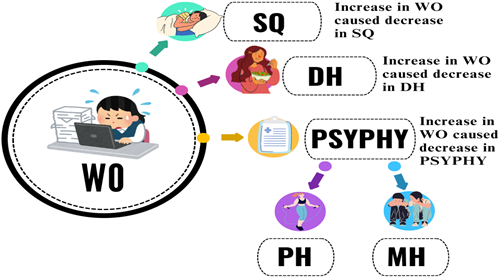
Figure 5. Flow Chart for Findings
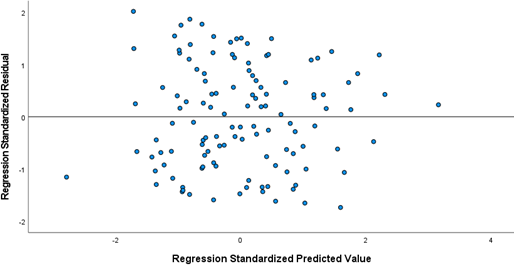
Figure 6. Scatterplot for Homoscedasticity Assessment
Findings in Table 3 showed that WO significantly influenced DH, SQ, and PSYPHY of study respondents which supported all the study hypothesis (H1, H2, & H3). The value of R2 (0.079) in Table 3 suggested a weak relationship of DH with WO. However, (b=0-.214, p<0.05) showed a statistically significant and modest effect on DH. Moreover, R2 (0.201) in Table 3 indicated a moderate relationship of SQ with WO but the (b=-0.426, p<0.05) demonstrated a significant meaningful impact of exposure on outcome. Furthermore, R2 (0.335) in Table 3 represented a strong relationship of PSYPHY with WO. Additionally, (b=-0.374, p< 0.05) confirmed the statically significant strong relationship of WO with PSYPHY.
Workplace obligations (WO) can lead to a variety of health challenges for working individuals. These obligations often result in fatigue and exhaustion, which can affect long-term performance and reduce the ability to work at full capacity. Prolonged workload pressure may cause individuals to overlook their health, increasing the risk of nutritional deficiencies and cognitive impairments over time. It is essential to implement strategies for managing workload effectively to ensure the overall health and well-being of academic professionals [13]. This study focused on understanding how workplace obligations (WO) impact dietary habits (DH), sleep quality (SQ), and overall psychological and physical health (PSYPHY) among academic professionals working in private universities in Pakistan. A cross-sectional survey was conducted, gathering data from 121 participants through structured questionnaires. The collected data were then analyzed statistically to explore the relationships between the variables.
The results showed a significant negative correlation (p < 0.05) between workplace obligations and dietary habits. Increased workplace stress was identified as a key factor, with stress and burnout influencing eating behaviors. This stress could lead to changes in caloric intake, either increasing or decreasing, depending on how individuals respond to the pressure [21, 22].
Similar study has previously been performed by Aljaber et al. (2019) which highlighted the effects of different academic stressors on eating habits of university students [23]. Additionally, another study reported an association of poor recovery from sleeping issues and work with unfavorable dietary habits. Tight deadlines, high work demands and feeling of being work overloaded elevated frequent issues with sleeping and dietary habits [24]. Our study findings concluded that WO had a significant (p<0.05) moderately strong negative correlation with SQ. SQ referred to the satisfaction of an individual on all aspects of the sleep. Academic professionals needed to maintain their health to perform their daily tasks at their workplace. Being overburdened at workplace might develop poor sleep habits and impact the quality of sleep [9]. Another, similar study was performed by Andrei et al. (2020) which supported that work demands were negatively correlated to the chronic fatigue and SQ [24].
The study also revealed a significant (p < 0.05) moderately strong negative correlation between workplace obligations (WO) and the psychophysical health (PSYPHY) of academic professionals. The findings suggest that workplace stress may contribute to psychophysical health issues, impairing both mental and physical well-being. [25]. Mental health could be disturbed among the academic professionals due to the amount of work they had to complete. This type of WO would cause emotional burnouts and decrease their abilities to deal with even normal level of stress. In this situation, psychological well-being or mental health could be observed to be disturbed in academic professionals [26]. Another literature study reported a negative association between work overload psychological wellbeing, workplace engagement and perceived organizational support. Work engagement could reduce the work overload and improvement in psychological wellbeing as a mediator [27]. Similar research data supported that WO caused emotional exhaustion and depersonalization among working population [28]. Another study showed that WO among the medical health care professionals could cause a long-term change in their performance at workplace. It was likely to make mistakes and errors when a professional was overloaded with the burden of work [29]. A balanced or normal workload might prove to be helpful in maintaining a good mental health. Another study showed a positive association of WO with emotional exhaustion [30]. Physical health was also got disturbed with WO at the workplace. A significant increase in workload negatively associated with physical health. Additionally, deteriorating physical health can often result from a significant increase in workload. Research has also shown that individuals working from home may experience negative physical health outcomes due to excessive work demands [31].
The aim of this study was to examine how workplace obligations (WO) impact dietary habits (DH), sleep quality (SQ), and psychological and physical health (PSYPHY) among academic professionals at various private-sector universities in Pakistan. The findings revealed a negative relationship between WO and all three variables—DH, SQ, and PSYPHY—indicating that increased workload was linked to poorer dietary habits, sleep quality, and overall health. These results highlight the need for further investigation into the underlying factors contributing to these associations and suggest the development of a standardized guideline to define an acceptable workload limit for academic professionals.
Acknowledgement
All authors are grateful to the institutions (University of Management and Technology, Lahore, Pakistan; University of Lahore, Lahore, Pakistan; Superior University, Lahore, Pakistan and University of Central Punjab, Lahore, Pakistan) for assisting us to collect data for the study.
REFERENCES