Comparative Efficacy of Pre and Post-Exposure Pro-Phylaxis Using Local Rabies Vaccine by IM Route
Kaneez Fatima1 | Shahid Nawaz1,2 | Firnas Ata Ur Rehman1 | Muhammd Furqan Shahid1 | Nadia Mukhtar1 | Tahir Yaqub1*
1Institute of Microbiology, University of Veterinary and Animal Sciences, Lahore.
2Institute of Microbiology and Molecular genetics, University of the Punjab, Lahore.
*Correspondence
Tahir Yaqub
Email: tahiryaqub@uvas.edu.pk
|
ABSTRACT Rabies is an infectious but preventable disease with proper vaccination. Pre-exposure prophylaxis means using medications or vaccines against a given pathogen in people who have not yet been exposed to the given pathogen. Post-exposure prophylaxis means the use of medications in people who are exposed to a certain pathogen. This study aimed to evaluate the seroconversion of anti-rabies IgG antibodies following the administration of the Indigenous rabies vaccine. For this purpose, n=150 individuals were enrolled with 20% in the pre-exposure prophylaxis group (PrEPG) and 80% in the post-exposure prophylaxis group (PEPG). The PEPG is further categorized into 3 different sub-groups [(2-15), (15-45), (>45) years] according to their ages. Indirect ELISA was used for the detection of antibodies IgG in serum samples. Seroconversion level revealed that the local vaccine used is effective in inducing immunity in individuals with OD values ranging from 0.76-≥2.92 about positive control OD values. Keywords: Rabies, Vaccine, Antibodies, ELISA, Infection |
Rabies is known as a fatal encephalitis provoked by different neurotropic viral strains of the family Rhabdoviridae. It moves by retrograde axoplasmic flow in peripheral nerves with 8-20 mm/day speed and the incubation period of the Rabies Virus varies from days to more than a year. Rabies virus is single-stranded RNA virus with five structural proteins. The saliva of the infected mammal is the major source of transmission, it gets entry through the wounds, abrasions or broken skin of victims. The victims of the Rabies virus are humans and other wild or domestic animals. Most wild animals are reservoirs of Rabies, and the vulnerability of the infection depends upon the species [1][2][3][4][5].
In most of the developing countries, it is endemic among stray animals, and dogs are blameworthy of human deaths in these areas. Dogs are responsible for 99% of the Rabies cases throughout the world. More than 50,000 deaths are attributed to rabies worldwide, almost 31,000 deaths occur in Asia and most children are the victims. In Asia, rabies is a major health problem but has not been given its due attention [6][7]. Children are at higher risk for the reason that children play with pet animals at home or visiting areas. Every day in Karachi Civil Hospital, Pakistan more than a quarter of hundred dog biting cases are reported. Highly threatening areas for rabies in Pakistan are Pishin, Khyber Pakhtunkhwa, Nasirabad, Punjab and Sindh, according to the National Rabies Control Program Pakistan [8]. Veterinarians are at high risk of getting this virus, they daily deal with animals and pets without even knowing the severity of infection. Hence, veterinarians are not only who are at high occupational hazard but butchers and farmers too [8][9]. In Pakistan, the locally produced Rabies vaccine was not available in the past. Rabies vaccine was imported from other countries and the high cost of imported Rabies vaccine was a major barrier for the prevention of Rabies. National Institute of Health (NIH), Pakistan started the production of the Rabies vaccine in recent years. For this purpose, they harvest the anti-rabies cell culture vaccine. This Rabies vaccine is bought by the government of provinces and is available free of cost for public. Since imported vaccines are costly and beyond the reach of common people, locally prepared vaccines can be more effective in eliminating rabies because they are easily available and cheap [10].
A significant titre of Rabies virus neutralizing antibodies (RVNA) of post-vaccination is an excellent indication towards the effectiveness of the vaccine used. ELISA (Enzyme linked immunosorbent assay) is more time-saving and simple procedure to check the quantity of the serum antibodies in humans [11][12]. The study aimed to check the efficacy of locally prepared Rabies vaccine by evaluating the titre of RVNA. As local rabies vaccines are economical as compared to the imported vaccines, significant results would mean that the country can save a plenty of money in terms of import of the vaccines. This can also encourage further efforts to prepare local vaccines for other diseases.
The research work was done at the dog bite centre, Institute of Public Health Lahore, Pakistan.
The ethical approval of this work was proceeded before the start of this work. The ethical approval was given by the institution's Ethical Review Board, Institute of Public Health Lahore Pakistan under the letter number 644/Bact on 18th December 2014.
During this study, total 150 individuals were registered by random selection from the Dog Bite Centre of IPH (Institute of Public Health), Lahore. Eighty percent (n=120) of the total participants were in the post-exposure prophylaxis group (PEPG), which was made up of veterinarians from IPH, whereas, twenty percent (n=30) were in the pre-exposure prophylaxis group (PrEPG). In PrEPG, all individuals fall in 15-45yrs age group and in this group, males were 21 (70%) and females were 9 (30%) with mean ages of 25.31 years and 24.33 years respectively. For the PEPG, total of 120 individuals were divided into three groups children (2-15yrs), adults (15-45yrs) and senior adults (>45yrs). Among 120 PEPG) were male children with mean age (11.24 years), n=18 were female children with mean age 12.70 years, n=40 were male adults with mean age (29.10), n=5 were female adults with mean age (32.26), n=14 were senior adult males with mean age 55.81 and n=1 was senior adult female with age (51). (Table 1) In PEPG 60 (50%) children were bitten by pet or stray dogs this indicates that children from age 2-15 years are more at risk more likely due to they are attracted to animals and play with them at homes and in the streets.
PEPG is further categorized according to the wound type (category II or category III) according to WHO wound classification and animal type (pet dog or stray dog) as shown in Table 1.
All participants selected for the study were over the age of two years and were readily available for blood sampling both during and after the vaccination process. Each participant demonstrated a willingness to provide accurate responses to the questionnaire administered as part of the study. Prior to their inclusion,
Table 1. Grouping of study data according to age and prophylaxis exposure
|
Pre-Exposure Prophylaxis Group n=30 |
Post-Exposure Prophylaxis Group n=120 |
||||||||||
|
2yrs-15yrs |
15yrs-45yrs |
>45yrs |
2yrs-15yrs |
15yrs-45yrs |
>45yrs |
||||||
|
Male |
NA |
21(25.31%) |
NA |
42(11.24%) |
40(29.10%) |
14(55.81%) |
|||||
|
Female |
NA |
9(24.33%) |
NA |
18(12.70%) |
5(32.26%) |
1(51%) |
|||||
|
Post Exposure Prophylaxis categorization according wound and animal type |
|||||||||||
|
Biting Animal |
Category II wound (n=66) |
Category III wound (n=54) |
|||||||||
|
Male |
Pet dog |
16(24.24% ) |
8(14.81%) |
||||||||
|
Stray dog |
44(66.66 %) |
28(51.85% ) |
|||||||||
|
Female |
Pet dog |
NA |
NA |
||||||||
|
Stray dog |
6(9.09% ) |
18(33.33% ) |
|||||||||
|
|
|||||||||||
Note: Figures in parenthesis show percentages within that category, NA= Not applicable, Statistical Analysis, Figures in parenthesis show mean age of that gender within the group, NA= Not applicable
written informed consent was obtained from all participants. They were thoroughly informed about the experimental nature of the vaccination trial and the subsequent publication of anonymized data.
The study specifically included individuals with Category II and Category III wounds, as defined by the World Health Organization (WHO) guidelines. Individuals with Category I wounds were excluded from participation. Additionally, potential participants with chronic illnesses, those who were pregnant or lactating, individuals taking immunosuppressant medications, or those undergoing other vaccination regimens were not considered eligible for the study.
Furthermore, chloroquine, a drug known to interact with rabies virus-neutralizing antibodies (RVNA) and potentially influence study outcomes (Pappaioanou, Fishbein et al., 1986), was identified as a confounding factor. Consequently, individuals using chloroquine for any medical reason were excluded from the study to ensure the integrity and reliability of the results.
The vaccine used in this study was manufactured by the National Institute of Health (NIH), Islamabad, and is referred to as the Vero Cell Locally Vaccine (VCIV). It contains 2.5 IU of purified and inactivated rabies virus, 0.5% human albumin as a stabilizer, and 60–90 µg of thimerosal to prevent contamination.
For the study, 5 mL of blood was collected from each participant. The blood samples were drawn into yellow-capped, gel-based vacutainers and centrifuged at 5000 rpm for 5 minutes. The resulting serum was then transferred into 1 mL microcentrifuge tubes, properly labeled, and stored at –20°C until further analysis. Blood samples were obtained from each participant before and after exposure on days 28, 60, and 90 to assess antibody titers. (Table 2)
Enzymatic immunoassay (Indirect ELISA) was carried out to confirm the anti-rabies glycoproteins (IgG) in humans and for this purpose PLATELIA RABIES KIT II in which peroxidase enzyme conjugated with Staphylococcus aureus is used. Seroconversion level of ≥0.5IU/ml is considered as the
Table 2. Inclusion and exclusion factors for the study Data Collection Categories and vaccine shots details
|
Inclusion Factors |
Exclusion Factors |
|||||
|
1 |
Selected individuals must be of >2 years of age. |
1 |
Individuals on other vaccination or already had received Rabies vaccine. |
|||
|
2 |
Selected individuals must be available for the post vaccination follow-up. |
2 |
Patients of chronic diseases. |
|||
|
3 |
Participants included in the study should provide accurate information asked in questionnaire. |
3 |
Patients using any immunosuppressant drug (Chloroquine) or have any surgical procedure during the trail. |
|||
|
4 |
In PEPG individuals must have category II or category III wound. |
4 |
Individuals with pregnancy or lactation status. |
|||
|
Group |
No of selected individuals |
vaccine dose |
Route of inoculation |
Day of vaccine shots |
||
|
PrEPG |
30 |
1ml |
Intramuscular |
0, 7, 28 |
||
|
PEPG |
120 |
1ml |
Intramuscular |
0, 3, 7, 14, 28 |
||
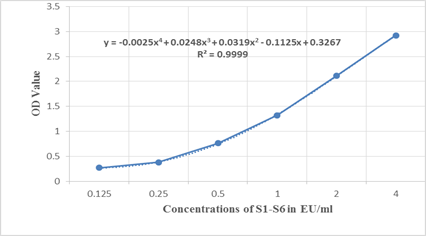
Figure 1. Optical density (OD) values of positive samples in standard curve
acceptable level by WHO standard of vaccine immunity. In this assay VCIV antibodies titre was measured in Equivalent unit per ml (EU/ml) which is equivalent to IU/ml. The positive solution named R4b is diluted (serial dilutions=S) S1-S6 (0.125EU/ml-4EU/ml) and then the Optical Density (OD) value calculated by spectrophotometer for each dilution. Standard curve was made for results.
At day zero, Rabies virus neutralizing antibodies (RVNA) titre of all the serum samples of PrEPG & PEPG was not detectable. PrEPG & PEPG serum samples post vaccination titres were significantly detectable through the ELISA kit. Serum samples of PrEPG (n=30) represented the same RVNA titre at 28th and 60th day and 20% of total 30 samples showed OD value more than S6 while 80% had sufficient RVNA titre.
At 90th day antibodies titre of 10% of total was remarkably high and 90% samples had OD value ranging from 0.76 to 2.926. All the samples of PrEPG had enough RVNA titre required to agglutinate the Rabies virus. (Table 3).
On 28th day, in PEPG, nearly three quarter of all age groups had sufficient quantity of RVNA and almost a quarter of total had a remarkably high titre of RVNA. All of the samples in the senior adult group, however, had adequate RVNA magnitude, and not a single serum sample had an OD of >2.926. In contrast, blood samples from adults and children showed remarkably high seroconversion levels of 17.5% and 10%, respectively. On 60th day, in PEPG, 20% in children, 25% in adults and 2.5% in senior adults appeared in high seroconversion level group with more than 2.926 OD value. On the other hand, 32.5% in children, 27.5% in adults and 12.5% in senior adults had sufficient level of RVNA. Blood serum samples on 90th had high to sufficient seroconversion level in all age groups. Amongst the children, 33 had high and 27 had sufficient and in adults 15 were with high and 20 were with sufficient quantity of IgG antibodies. While in senior adults all serum samples (15) were within S3-S6 (0.76-2.926) range. (Table 4)
Table 3. Results of post vaccination serum sample at different days in PrEPG
|
Days of sampling |
Seroconversion Level in individuals n=30 |
|||
|
High |
Sufficient |
Insufficient |
Not detectable |
|
|
>S6 (>2.926) |
S3-S6 (0.76-2.926) |
S1-<S3 (0.27-<0.76) |
< S1 (<0.27) |
|
|
28th |
6(20%) |
24(80%) |
NA |
NA |
|
60th |
6(20%) |
24(80%) |
NA |
NA |
|
90th |
3(10%) |
27(90%) |
NA |
NA |
Note: Figures in parenthesis show percentages within that category NA= Not applicable.
Table 4. Results of post vaccination serum sample at different days in PEPG
|
Day of sampling |
Age Groups (years) |
Seroconversion Level in individuals n=120 |
|||
|
High |
Sufficient |
Insufficient |
Not detectable |
||
|
|
|
>S6 (>2.926) |
S3-S6 (0.76-2.926) |
S1-<S3 (0.27-<0.76) |
< S1 (<0.27) |
|
28th |
2-15 |
21(17.50%) |
39(32.5%0) |
NA |
NA |
|
15-45 |
12(10%) |
33(27.50%) |
NA |
NA |
|
|
Above 45 |
NA |
15(12.50%) |
NA |
NA |
|
|
%60th |
2-15 |
24(20%) |
36(30%) |
NA |
NA |
|
15-45 |
30(25%) |
15(12.50%) |
NA |
NA |
|
|
Above 45 |
3(2.50%) |
12(10%) |
NA |
NA |
|
|
90th |
2-15 |
33(27.50%) |
27(22.50%) |
NA |
NA |
|
15-45 |
15(12.505) |
30(25%) |
NA |
NA |
|
|
Above 45 |
NA |
15(12.50%) |
NA |
NA |
|
Note: Figures in parenthesis show percentages within that category. NA= Not applicable
According to the WHO-recommended Post–Exposure Prophylaxis (PEP) "ESSEN” regimen post-exposure treatment depends on the type of exposure and consists of no treatment for category I, vaccine alone for category II, and immediate treatment by vaccination therapy with rabies specific immunoglobulin for category III. Suturing of wound is strictly prohibited. One of the most recommended post-exposure prophylaxis protocols (ESSEN protocol) includes five single dose of vaccine (1-1-1-1-1) over a 28-day period with intramuscular (IM) administration at deltoid muscle of cell culture rabies vaccine is recommended by WHO [13]. For the pre-exposure prophylaxis, WHO Expert Committee in 1984 recommended the three single dose of Rabies vaccine at 0, 7 and 28 days (1-1-1). Three doses antibodies titre was much more as compared to two doses titre while in this study serum samples of PrEPG (n=30) represented the same RVNA titre at 28th and 60th day and 20% of total 30 samples showed OD value more than S6 while 80% had sufficient RVNA [14]. In this study, ESSEN protocol for the post exposure group and three doses protocol for pre-exposure group were used. Inducing a quick response as soon as possible after exposure to the rabies virus to prevent its progress towards the central nervous system is the most critical criterion for the effectiveness of any post-exposure therapy [10]. The present study was focused on the evaluation of the locally vaccine formulated by NIH, Pakistan.
The aim of this study was to check the efficacy of VCIV in the study subjects with reference to the WHO recommended titre of ≥0.5 IU/ml which is considered as acceptable titre of immune response. In present study, at 90th day antibodies titre of 10% of total was remarkably high and 90% samples had OD value ranging from 0.76 to 2.926. All the samples of PrEPG had enough RVNA titre required to agglutinate the Rabies virus [15]. Sufficient antibodies titre against antigen is considered as best indicator to protect from infection [16]. ESSEN regimen was followed as per WHO recommendation. In another study [17], the same protocol was followed the efficacy of Purified Vero cell lines were checked to design Rabies vaccine to induce immunity. Other protocols of vaccine inoculation are also recommended by WHO, many studies compared the efficacy of these protocols and production of anti-Rabies antibodies is not much affected by the type of protocol adopted for the vaccination rather, it depends on the quality of vaccine. In one study, the Zagreb protocol was compared whose tenacity was less than ESSAN [18].
FAVN and RFFIT are the reference tests used for the IgG antibodies detection against Rabies. However, authoritative professional laboratories with high level of expertise are required to perform these tests so, ELISA is a good alternative with much reliability and accessibility [19] [20]. PLATELIA™ RABIES II ELISA kit detects neutralizing antibody titre which is superior to several currently employed serological techniques in many respects. It is quick, safe, and easy to use, shows less virulent strain viral manipulation. Coloured reagents are used with standardized controls in relation with international reference criteria [21]. In this study, on 28th day, in PEPG, nearly three quarter of all age groups had sufficient quantity of RVNA and almost a quarter of total had a remarkably high titre of RVNA. However, in senior adult group not a single serum sample had OD of >2.926, all the samples of that age group possessed sufficient magnitude of RVNA, the possible reasons could be (Immunosenescence, lower T-cell Function and any other pre-existing health conditions. While in children and adults serum samples had 17.5% and 10% respectively notably high seroconversion level. On 60th day, in PEPG, 20% in children, 25% in adults and 2.5% in senior adults appeared in high seroconversion level group with more than 2.926 OD value. Antibodies titre up to three years following the vaccination through five dosses protocol were studied in Turkey with 186 persons (60 females & 126 males) which was between 2-90 years. IgG antibody titres were determined by using a commercial ELISA kit (Platelia Rabies II BioRad, France) which was also used in present study for detection of antibodies. According to the study the rate of protective antibody positivity was low (70%) even in full programme vaccinated cases and this might be attributed to age of the person, the length of time after vaccination, number of vaccinations, storage or transport condition of the vaccine and more importantly negligence in booster dose [22]. However, in present study antibody titer was checked in post and pre-exposure patients within 3 months of post vaccination all aged group had protective antibody titer. Four different Rabies vaccines were compared by a group of researchers [23] for their safety among people at different ages who received PEP after WHO category II animal exposure. Among these, vaccine one was Vero cell rabies vaccine. They studied their adverse reaction; Vero cell did not induce much adverse effects on children under the age of 5 than subjects of 3 other age groups in their study. Vero cell vaccine seemed to be safer than the other 3 vaccines for children under the age of 5. Vero cell rabies vaccine was also used in present study, during one month of vaccination period there was no significant adverse effects have been seen in any aged group including aged 2 – 90 years [24][25][26][27][28].
Cell culture Rabies vaccine is very common and available throughout the world. However, rabies remains endemic to many parts of the developing world where the resources of appropriate prophylaxis are limited, the infrastructure and facility are inadequate, and, most importantly, awareness about rabies is lacking. In this study locally developed vaccine by the NIH of Pakistan was shown to be effectively protecting different age groups with the presence of remarkably higher titers of IgG antibodies against Rabies. The vaccine is safe to use and can provide a greater boost to the overburdened and fragile health system of Pakistan.
Declaration
The Authors declare no conflict of Interests
Acknowledgements
University of Veterinary and animal science, NIH and IPH dog bite center are duly acknowledge