Demographic Characteristics and Knowledge, Attitude, and Perception (KAP) Survey on COVID-19 Immunization among Pakistani Population: A Cross-Sectional Study
|
1Department of Microbiology and Molecular Genetics, The Women University Multan, Pakistan *Correspondence Saher Mahmood Email: saher.9006@wum.edu.pk |
Laraib Aslam1 | Mahnoor1 | Saher Mahmood1*
|
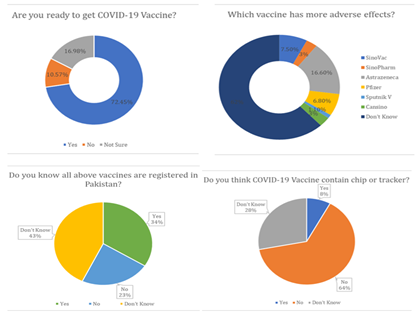
ABSTRACT The disastrous calamity of coronavirus disease, is accountable to wreak havoc on human health and economy, thus World Health Organization has declared it as a public health emergency of international concerns. This study is aimed to obtain the demographic and KAP (knowledge/attitude/perception) survey data, regarding coronavirus immunization. A questionnaire-based online cross-sectional survey was undertaken in Pakistan from May 2021 to June 2021. Data was analyzed using IBM SPSS v 21 and p<0.05 was considered significant. Among 265 participants, results of demographic data survey showed that 74% were females and 26% were males, including >80% respondents from Punjab, and 99.24% Muslims. p<0.05 was obtained for 20-29 years old students belonging to life sciences accountable for 65% overall as a significant result. In KAP survey, the obtained data showed sub-optimal results as: 72.45% participants were ready to get COVID-19 vaccine, 50.20% people got vaccinated due to health concerns, 34% knew about vaccine registration in Pakistan, 62% did not know about adverse effects while 16.60% reported about AstraZeneca side effects, 42% preferred testing before getting vaccine, 67% had no knowledge regarding preventive measures after vaccination, 26% found vaccines effective, 52% thought of getting COVID-19 after vaccination, 39% preferred second dose of vaccine (in case of allergic reaction after getting first dose), and 64% did not think about the tracker in the chip. Pakistani community has a positive attitude towards COVID-19 vaccines, but due to lack of knowledge, immediate awareness programs are mandatory to be conducted to complete mass vaccination. |
|
Keywords: COVID-19, Demographic data, KAP survey, Vaccination |
1. INTRODUCTION
Coronaviruses are encapsulated, single stranded, and large RNA viruses, firstly characterized by Tyrell and Bynoe in 1966 [1]. In December 2019, a rare coronavirus triggered a sequence of nosocomial infections in Wuhan, China. SARS-CoV-2 and 2019-nCoV are two titles for this putative coronavirus, as per the World Health Organization [2]. Through asymptomatic individuals to sepsis and various organs failure, COVID-19 induces a wide variety of health conditions. Individuals with a minor discomfort may display signs of an upper nasopharyngeal viral illness. The majority of COVID-19 cases are of low severity [3]. Patients with modest disease can swiftly progress to severe or dangerous situations [4].
Chronic diseases are more likely to develop in those over the age of 65, as well as those with preexisting medical disorders such as cardiovascular disease, chronic respiratory disease, diabetes, and cancer [5]. COVID-19 sufferers frequently encounter temperature, difficulty breathing, cough, stiff neck, nasal congestion, vertigo, shivers, muscle soreness, arthralgia, tiredness, sleepiness, or arthralgia, shortness of breath, increased mucus production, coughing up blood from respiratory tract, and breathlessness. More than one symptom is present in around 90% of individuals. COVID-19 is anticipated to have a one-to-four ratio of severe to common instances [6].
To control the condition, there are no effective medications or vaccines that can be recommended. The quickest way to avoid transmission is to wash with soap and water for 20 seconds on a regular basis, wipe the nose and mouth with a handkerchief/twisted forearm, when you sneeze or cough, don't touch your eyes, nose, or mouth with filthy fingers, and if you're unwell, remain at home and distance yourself from everyone else [7]. COVID-19 confinement by separation represents the most powerful strategy. The catastrophic numbers of infections, morbidities, and deaths during the COVID-19 pandemic, as well as the devastating economic consequences, have necessitated a historically unprecedented attempt to develop an effective vaccine [8].
Vaccines are administered to the body by the mouth, injection, or nasal route to stimulate the immune system's response against foreign substances [9]. Six Covid vaccines have been approved in Pakistan so far. Sinopharm, Sinovac [10], Astrazeneca, Sputnik V, CanSino, and Pfizer's vaccine [11]. According to a report published by Pakistan's National Institute of Health on June 10, 2020, there are 43460 confirmed cases in Punjab, followed by Sindh (41,303), KP (14,527), Balochistan (7,031), Islamabad (5,663), Gilgit Baltistan (974), and AJK (444) The majority of recoveries were reported in Sindh (21,007), Punjab (9,005), KP (14,527), and Balochistan (3,771) [12]. Pakistan has a 1.3 percent death rate and a 4.8 percent recovery rate. The Pakistani government is taking all necessary steps to combat COVID-19 and ensure that the state's commitments to its citizens are met [13].
The COVID-19 vaccination has primarily modest and self-resolving adverse effects. After receiving the vaccination shot, one may have side symptoms such as a sore arm, low-grade fever, or body aches, however the vaccine protects against COVID-19 infection. If any symptoms appear, they normally only last a day or two. According to current standards, people who have already been diagnosed with COVID-19 should still be vaccinated because there is a danger of reinfection. Participants who were immunized after contracting COVID-19 showed a robust immune reaction following each of the first two shots with the Pfizer and Moderna vaccines, as per findings. In nations like Pakistan, vaccine reluctance is a major obstacle to ending the pandemic [14].
SARS COVID-19 also known as Corona virus pandemic has devastatingly influenced the human life in many ways. Development of vaccines has boosted up the people immunity against the life-threatening infections and thus helped to reduce the global burden of disease. Various myths concerning the security and health aspects, spread via different social media platforms. There is a little information about public opinions and acceptance of the SARS COVID-19 vaccination in Pakistan. This survey-based study aimed to evaluate the key concerns of people who are unwilling to get vaccinated despite the fact that COVID-19 vaccine is available for free, as well as possible solutions to this problem.
2.1 Study Design and Data Collection
To assess the awareness and knowledge of the general population about SARS COVID-19 vaccination, an online self-administrated questionnaire-based survey was conducted throughout the Pakistan. Questionnaire was based on literature studies and consisted of two sections: First part was related to demographic information like gender, province, age, religion, education, and field of study. The second part was KAP survey i.e. knowledge, attitude, and perceptions of people towards coronavirus and its vaccines. The targeted sample for the study were the population which was more aware of social media as the online questionnaire was sent to most of the people encountered with different social platforms. The major aim of any questionnaire was to collect relevant information in most reliable and valid way, hence it was must for respondent to enter the email address in the questionnaire.
2.2 Statistical Analysis
Data was organized and each response was coded and analyzed using IBM SPSS v 21. Findings were displayed in numbers and respective percentages as a result of descriptive statistical analysis.
3 RESULTS
3.1 Demographic Survey Data Analysis
To analyze and assess the awareness, acceptability, and knowledge of public about the corona vaccine, a self-generated questionnaire-based research was conducted and circulated throughout different provinces of Pakistan. A total of 265 responses were received among which 74% were males and 26% were females. They were belonging to different to various age groups, different provinces, religions, educational backgrounds and field of study. All the results of demographic section with p-value of vaccination status are listed below.
Table 1. Demographic data
|
|
Measure/ Parameter |
% of the respondents |
|
1. |
Gender |
|
|
|
Males |
26% |
|
|
Females |
74% |
|
2. |
Province |
|
|
|
Punjab |
85% |
|
|
KPK |
5.20% |
|
|
Balochistan |
0.75% |
|
|
Gilgit Baltistan |
38% |
|
|
AJK |
3.77% |
|
|
Sindh |
4.90% |
|
3. |
Age Group |
|
|
|
Under 19 |
11% |
|
|
20-29 |
65% |
|
|
30-39 |
18% |
|
|
40-49 |
4.15% |
|
|
50-59 |
0.75% |
|
|
60 and above |
0.40% |
|
4. |
Religion |
|
|
|
Christian |
0.38% |
|
|
Hindu |
0.38% |
|
|
Muslim |
99.24% |
|
5. |
Education |
|
|
|
Matric |
4.50% |
|
|
Intermediate |
8.30% |
|
|
BS(Hons)/ MSc |
49% |
|
|
MPhil |
27% |
|
|
BA/B.Ed. |
3% |
|
|
MA/M.Ed. |
1.90% |
|
|
MBBS |
4.50% |
|
|
PhD |
2.64% |
|
6. |
Field of Study |
|
|
|
Arts |
7.90% |
|
|
Life Sciences |
65.30% |
|
|
Commerce |
20% |
|
|
Engineering |
6.80% |
Table 2. Vaccination status and p-value
|
Measure/ Parameter |
Population |
p-value |
|||
|
Vaccinated |
Non-vaccinated |
||||
|
1 |
Gender |
||||
|
Males |
46 |
22 |
0.745 |
||
|
Females |
129 |
68 |
|||
|
2 |
Province |
||||
|
Punjab |
150 |
75 |
0.7834 |
||
|
KPK |
09 |
05 |
|||
|
Balochistan |
01 |
01 |
|||
|
Gilgit Baltistan |
00 |
01 |
|||
|
AJK |
06(AJK, Seychelles) |
04(AJK, FATA, 2 India) |
|||
|
Sindh |
09 |
04 |
|||
|
3 |
Age group |
||||
|
Under 19 |
16 |
14 |
0.0141 |
||
|
20-29 |
108 |
63 |
|||
|
30-39 |
40 |
9 |
|||
|
40-49 |
9 |
2 |
|||
|
50-59 |
2 |
0 |
|||
|
60 and above |
0 |
2 |
|||
|
4 |
Religion |
||||
|
Christian |
01 |
0 |
0.5956 |
||
|
Hindu |
01 |
0 |
|||
|
Muslim |
173 |
90 |
|||
|
5 |
Education |
||||
|
Matric |
32 |
21 |
0.0260 |
||
|
Intermediate |
|||||
|
BS(Honours)/ MSc |
136 |
44 |
|||
|
MPhil |
80 |
24 |
|||
|
BA/B.Ed. |
|
|
|||
|
MA/M.Ed. |
|
|
|||
|
MBBS |
14 |
1 |
|||
|
PhD |
80 |
24 |
|||
|
6 |
Field of study |
||||
|
Arts |
28 |
13 |
0.9326 |
||
|
Life Sciences |
116 |
60 |
|||
|
Commerce |
31 |
17 |
|||
|
Engineering |
|
|
|||
Note: p-value<0.05 was considered significant
3.2 KAP Survey Data Analysis
KAP survey was conducted to assess the public knowledge, attitude, and perception, regarding the pandemic and vaccines. For this purpose, a questionnaire containing 12 different queries was generated, and results are listed below.
Figure 1. Data represented the knowledge of participants regarding COVID vaccine with most adverse effects
Figure 2. Data is representing the concerns of participants regarding COVID-19 vaccine
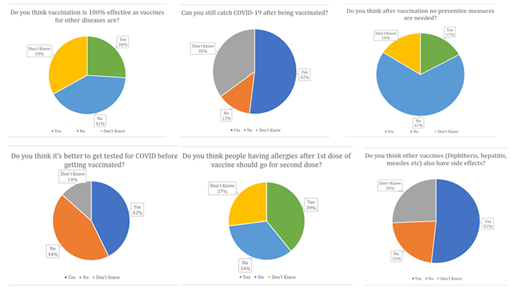
Figure 3. Responses of the participants of why they got vaccinated or going to be vaccinated
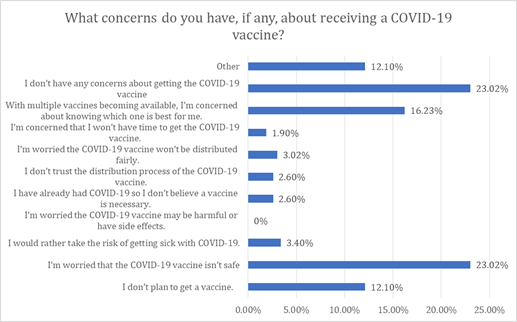
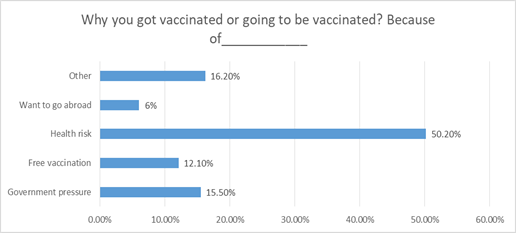
Figure 4. COVID-19 vaccination and concern of health risk among participants
Table 3. % representation of KAP survey data analysis
|
KAP (knowledge, attitude, and perception) survey |
Yes |
No |
Do not know |
|
|
1 |
Do you think vaccination is 100% effective as vaccines for other diseases are? |
26% |
41% |
33% |
|
2 |
Can you still catch COVID-19 after being vaccinated? |
52% |
13% |
35% |
|
3 |
Do you think after vaccination no preventive measures are needed? |
17% |
67% |
16% |
|
4 |
Do you think it’s better to get tested for COVID before getting vaccinated? |
42% |
44% |
14% |
|
5 |
Do you think people having allergies after 1st dose of vaccine should go for second dose? |
39% |
34% |
27% |
|
6 |
Do you think other vaccines (Diphtheris, hepatitis, measles etc) also have side effects? |
52% |
22% |
26% |
|
7 |
Do you know all above vaccines are registered in Pakistan? |
34% |
23% |
43% |
|
8 |
Do you think COVID-19 Vaccine contain chip or tracker? |
8% |
64% |
28% |
|
9 |
Are you and your family vaccinated for COVID-19? |
66% |
29% |
5% |
4 DISCUSSION
Numerous vaccine nominees have obtained approvals for the emergency usage up till now, and several nations have instigated the vaccination rollout attempts [15]. The goal of this study was to look at the acceptance of SARS COVID-19 vaccines, as well as public perceptions of these vaccines in Pakistan through a survey-based study. Throughout the pandemic, people used divergent resources to gather knowledge regarding the disease, for example radio, newspapers, television, social media, friends, healthcare providers, etc. Health care providers were at the top of the list when the participants were inquired about the most-trusted source of information according to our survey.
A total of 265 responses regarding the awareness were collected, 26% from males and 74% from females. Demographic attributes like age, gender, locality, religion, educational background were also checked with immunization status. The median age (20-29 years old) of participants in our study were more vaccinated as they are socially active/are students/do jobs so they have more awareness knowledge. More than half of the respondents (85%) were from Punjab, as it is one of the most populated provinces of Pakistan. Similarly, as Pakistan is a Muslim state, so based on their religious belief, majority of the respondents (99.24%) were Muslims.
Szmyd, Bartoszek, Karuga, Staniecka, Błaszczyk and Radek [16] looked at the vaccine apprehension of medical and non-medical students. The majority of the pupils polled indicated that they needed to be immunized for COVID-19. Among medical students, 91.99 percent were intended to get immunized, in comparison to non-medical students as among them 59.42 percent were ready to get vaccinated. One of most serious issue, meanwhile, was the possibility of disease spreading to the senior citizens. Social networking and relatives were the least trustworthy data sources, correspondingly.
51% of the respondents said that they could and 49% believed that they would not get COVID after vaccination. Among respondents who had biology or medical background, 54% said that individual could catch COVID even after vaccination. Whereas CDC stated that it could be rare that vaccinated individual catch COVID [17]. The NCOC government of Pakistan also stated that there are no evidence so far which could prove that the vaccine could not be effective against new variants [18].
Among all the respondents, 43% were in favor of being tested before getting vaccination for COVID-19 whereas 57% thought that there is no need of this, or they don’t know about the idea. According to CDC, if anyone have COVID should wait to get recovered before taking vaccination. Even if someone get COVID between two shots of vaccination, should also wait to be recovered before getting second dose. But there is no need to get tested for COVID before vaccination because asymptomatic corona gives false negative results [17].
When the participants were asked about their opinion regarding to take second dose of vaccination or not if individual get allergy after first dose of vaccination. 39% respondent thought that it would be ok to get the second dose however, 61% were not in the favor. As reported by CDC (Centre for Disease Control and Prevention), if anyone got allergic reaction after first dose, either its severe or not, should not go for the second one. Allergic reaction could be respiratory distress (wheezing), swelling or hives. If anyone get rash on the arm after vaccination should go for the second dose but on the opposite arm [17]. 52% of the participants responded that vaccines of other diseases like measles, Diphtheris and hepatitis also have side effects, however, 48% were not aware of those other vaccines can also cause side effects. There are many other vaccines which can cause rash at the injection site, fever or allergy but it is nothing to bother about as advantage of vaccines overshadow the risk of side-effects. Usually, vaccines are safe and their serious side-effects are very rare [19].
When it was asked from the participants that which vaccine (Sinovac, Sinopharm, Astrazeneca, Pfizer, Sputnik or CansinoBio) has more side effects, 61% of the participants were not aware of whereas 44% participants thought that AstraZeneca has more side effects among all 6 vaccines. It is reported by the Wise [20] that due thromboembolism, the use of AstraZeneca has been halted in the European countries. The reason is one of the components which could stick to a protein releases by the platelets during blood clot formation. These molecular clumps could be taken as foreign invaders by the body and responsible to trigger the reaction cascade that turn platelets into blood clots [21].
According to the investigation conducted by Rzymski, Zeyland, Poniedziałek, Małecka and Wysocki [22] AstraZeneca vaccine was the least trusted one by the respondents. The median level of fear which was observed in the analyzed group was 4.0 which reflected that chiefly associated with the risk of severe allergic reactions, unknown long-term effects of vaccination as well as other critical and undesirable outcomes. When the participants were asked that either they know or not that the vaccinations available in Pakistan are registered and approved, 66% participants were not aware of the facts. Among them approximately 62% were the participants with biological or medical background.
A study conducted in Jordan by El-Elimat, AbuAlSamen, Almomani, Al-Sawalha and Alali [23] intended to explore the suitability of COVID-19 vaccines coupled with its forecasters besides the stances in the direction of these vaccines amongst the public in Jordan. This study found out that those individuals above age 35 years old (besides working contributors) were least anticipated receiving the COVID-19 vaccines. Furthermore, the participants who assumed that there was a stratagem at the back of COVID-19 plus those who do not trust any basis of evidence on COVID-19 vaccines were less probable to have acceptance towards the vaccine. Likewise found in the present study that the people having trust issue regarding to vaccine were not ready to get vaccine.
5.CONCLUSION
This present study has obtained encouraging data regarding awareness about coronavirus in terms of demographic data. A p-value of less than 0.05 was obtained for median (20-29 year) age group and education. Thus it is concluded that the Pakistani community has a positive attitude towards COVID-19 vaccines. But owing to the inadequate knowledge due to sub-optimal results obtained in KAP survey data, it is mandatory for the authorities to conduct immediate awareness programs to provide education regarding vaccines. In this way, we may be able to achieve the mass vaccination schedule. There is also a need to implement public sensitization programs to control outbreaks of COVID-19 in future.
REFERENCES