Dengue dilemma, Understanding and confronting Dengue in Pakistan
Aqsa Shafique,1 Abdur Rehman,1 Hira Muzammal ,1 Aleena Haqqi1*
1School of Medical Laboratory Technology, School of Allied Health Sciences, Lahore 54000, Pakistan
Correspondence: aleenahaqqi005@gmail.com
Dear Editor,
Recent epidemiological reports suggest that Dengue cases are on the rise in Pakistan, and need immediate attention[1]. Dengue viruses (DENV) belong to the flavivirus genus, with a diameter of 50nm, the dengue virus is spherical, encapsulated, and composed of a single, positive-sense RNA genome with roughly 11, 000 nucleotides and a single open-reading frame. A single polyprotein precursor organized in an NH2-C-prM-E-NS1-NS2A-NS2B-NS3-NS4A-NS4B-NS5-COOH sequence is encoded by this open reading frame [2]. It has four serotypes (DENV-1, DENV-2, DENV-3, DENV-4). The most significant vector is the Aedes aegypti mosquito [3].
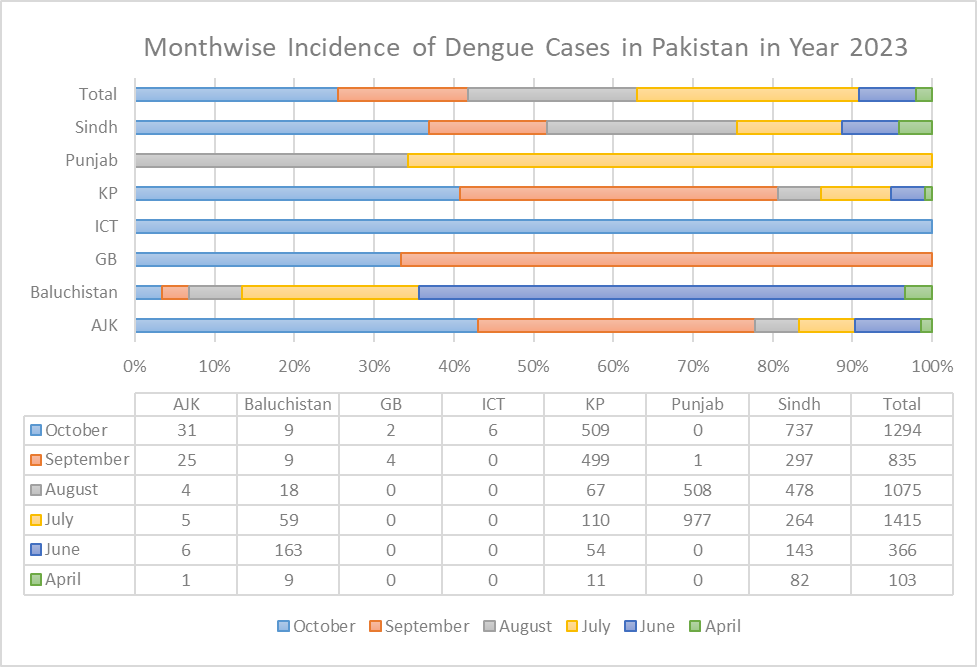
According to reports, by the end of September, 5,469 confirmed dengue cases were reported in the 36 districts in Punjab in the year 2023. Lahore alone reported a staggering 2,130 cases, followed by 1,561 cases in Rawalpindi, 620 cases in Multan, 268 cases from Gujranwala and, 245 cases from Faisalabad 1. According to the National Institute of Health (NIH), Islamabad Pakistan, 5088 dengue cases were reported from all the provinces of Pakistan in April-October (data collected and compiled from Integrated Disease Surveillance & Response (IDRS) Reports by NIH, Islamabad [4]. The highest reported cases were from Sindh and Punjab contributing 2001 and 1486 cases from a total of 5088 dengue cases in Pakistan despite the non-reported cases from Punjab as shown in figure 1. The number of reported cases might not be accurate as most of the cases go unreported and un-detected in Pakistan healthcare settings.
Figure 1. Month wise Incidence of Dengue Cases in Pakistan in the Year 2023
Dengue fever has continued to affect the population of Pakistan, especially in the post-monsoon season (20th September – 5th December). The reported dengue cases might not be accurate but it gives a rough estimate of the situation as most of the cases are not reported. The year-wise report of NIH, Islamabad reported 22,938, 3,200, 24,547, 3,422, and 48,906 dengue cases in years 2017, 2018, 2019, 2020, and, 2021 respectively [5]. In 2022, a total of 25,932 confirmed dengue cases and 62 deaths were reported with a case fatality ratio of 0.25% depreciating from 0.40% in 2021. The highest reported dengue cases in 2022 were from Sindh and Punjab contributing to 6,888 and 6,255 followed by Khyber Pakhtunkhwa and Baluchistan [6].
The viral structure of DENV consist of seven nonstructural protein (NS1 , NS2 , NS2B , NS3 , NS4A, NS4B, NS5 ) and three structural protein the capsid(C) membrane (M) (which involve a membrane precursor or prM ) , and envelop (E) [7]. The DENV utilizes dendritic cells of host cell machinery to replicate and infect macrophages, monocytes and lymphocytes. Clinically, Dengue fever can be characterized by symptoms ranging from mild to severe dengue hemorrhagic fever (DHF) or dengue shock syndrome (DSS), leading to increased vascular permeability, thrombocytopenia and leucopenia. The primary infection results in the activation of immune response against DENV immunological serotypes as well as antibody-dependent enhancement (ADE). Other symptoms include headache, joint pain, muscle pain, fatigue, skin rashes, vomiting and bleeding from nose and gums [8].
The dengue outbreak due to favorable atmospheric conditions is suspected to result in dengue outbreak from mid-September to the start of December. So, it is advised for authorities to take appropriate preventive measure, report accurate dengue cases and run educational campaigns for local people so that the outbreak can be prevented.
Acknowledgments:
We would like to acknowledge our mentors
Author Contributions:
All authors conceived the study, discussed the results, A. Shafique drafted the first manuscript, A. Rehman formatted the article according to journal. A. Haqqi critically read and revised the manuscript, and gave final approval for publication.
Conflict of Interest:
All the authors declare no competing interest.
Funding Sources
No Funding was used to compile this research
Data availability Statement
All the data utilized in this article was publicly available
References