Hormetic Response of Turnip Seedlings to Aqueous Extracts of Withania coagulans Seed and Cassia fistula Fruit
Rizwan Maqbool1*| Burhan Khalid1 | Nazma Khan2 | Alvina Amjad2 | Muhammad Ather Nadeem3
1Department of Agronomy, University of Agriculture, Faisalabad, Punjab, Pakistan
2Department of Botany, University of Agriculture, Faisalabad, Punjab, Pakistan
3Department of Agronomy, University of Sargodha, Sargodha, Punjab, Pakistan
*Correspondence
Rizwan Maqbool
Email: rizwan.maqbool@uaf.edu.pk
|
ABSTRACT Allelochemicals found in plants are gaining favor as biostimulants and alternative growth regulators in agriculture. Withania coagulans and Cassia fistula are known to produce numerous secondary metabolites, such as phenolic compounds, that can regulate seed germination and seedling growth. This study investigated the allelopathic effects of aqueous extracts from Withania coagulans seeds and Cassia fistula fruits on turnip germination and seedling growth. Laboratory experiments were conducted using extract concentrations of 0, 2.5, 5, 10, 20, 40, and 80 g/L. Therefore, this paper hypothesized that low concentrations would induce growth in a hormetic manner, whereas higher levels would inhibit it. Results revealed a hormetic response, where lower concentrations of W. coagulans extract (2.5 and 5 g/L) significantly increased root length (41.5% and 24.3%, respectively), root fresh weight (by 72.5% and 63.5%), and shoot fresh weight (by 59.5%), while reducing mean emergence time, and time to 50% emergence compared to the control. Higher concentrations (10-80 g/L) inhibited germination, with complete inhibition observed at 40 and 80 g/L. C. fistula extracts exhibited more complex interactions, with the 40 and 80 g/L concentrations enhancing shoot length and fresh weight, and 80 g/L also increased germination percentage. Phenolic compounds such as quercetin, ferulic acid, gallic acid, and p-coumaric acid identified in both extracts may contribute to these effects. This study demonstrates the hormetic effect of the W. coagulans and suggests that low concentrations (2.5-5 g/L), particularly (2.5 g/L), may serve as a natural growth enhancer to improve turnip growth and yield. Keywords: Allelopathy, Growth, hormesis, Natural, Phenolics, Phytotoxicity, Sustainable, Turnip |
Allelopathy and hormesis are the most important mechanisms in plants through which they release chemicals that can change how other plants grow. Sometimes these chemicals slow down the growth of other plants and sometimes stimulate the growth which depends on the concentration of the chemical. The knowledge about allelopathy and hormesis is becoming a useful tool for to increase the crop productivity by sustainable agricultural practices [1, 2]. Allelochemicals are released by plants and different allelochemicals that act in diverse ways, and their effects vary with the concentration and plant species [3, 4]. Most plant species can experience this concentration-specific response, known as hormesis, when they receive exposure to a chemical stimulus. Hormesis is thought to be a mechanism of evolution that allows plants to thrive in chemically challenging circumstances [5, 6]. Coagulans, which grows naturally in South Asia, has shown allelopathic activity in earlier studies [7]. Its seeds and other parts contain withanolides and phenolic compounds that can either promote or inhibit the growth of nearby plants [8, 9]. Another species of interest Cassia fistula, a leguminous tree that produces compounds known to influence germination and early growth [10]. Until date, no previous studies have shown how extracts from W. coagulans seeds or C. fistula fruits affect turnip (Brassica rapa). The current study was therefore aimed at evaluating the above effects on germination of seeds and growth of seedlings.
Turnip is a common vegetable that many people grow for its edible and nutritious roots and leaves [11]. The discovery of natural and safe approaches to the increase of turnip yield is essential to sustainable food production and is a major research priority of sustainable agriculture [12]. Using plant extracts instead of chemical growth regulators may represent a promising alternative because they are environment-friendly and pose fewer risks to people and the environment [13, 14].
Although many plants have been examined for allelopathic effects, little research has been conducted on W. coagulans and C. fistula. The majority of the published studies focus on Parthenium hysterophorus, Eucalyptus, or Brassica residues. The chemistry of the two species that we studied differs greatly from each other. W. coagulans is rich in withanolides and phenolics, and C. fistula is also known to have acids like gallic, vanillic, and ferulic. Due to such differences, it is anticipated that both species will have different impacts on other plants. No previous research had studied their effect on Brassica rapa, so this study aimed to fill that gap. This study determined the effects of aqueous extracts of W. coagulans seeds and C. fistula fruits on the germination and growth of turnip seedlings. We hypothesized that the seedlings would grow well at low extract levels but would show reduced growth at high levels. Such information about the pattern of hormesis could help farmers or scientists to develop sustainable methods to enahnce crop performance and control weeds.
To test our hypothesis, laboratory experiments were conducted to investigate the germination and growth of turnip (B. rapa). Several concentrations of W. coagulans seed extracts and C. fistula fruit extracts were tested for measuring root and shoot length, fresh weight, average emergence period, and germination percentage. High-performance liquid chromatography (HPLC) was also used to identify which phenolic compounds were present in the extracts of W. coagulans seeds and C. fistula fruits. For this purpose, dried samples of W. coagulans seeds and C. fistula fruit were powderedfinely, and used 10 mg of each powdered sample mixed with 90% methanol. Next, the extracts were covered with aluminum foil and allowed to macerate over a 10-day period at room temperature. The samples were then filtered, and the solvent was evaporated under low pressure following the maceration. The dried residues were reconstituted in methanol and analyzed with the HPLC system that has an SPD-10AV detector and an LC-10AT pump [24]. The target separation was performed on a reverse-phase C18 column using a gradient elution system, where the mobile phase was water (acidified with 0.1% formic acid) and acetonitrile. The phenolic compounds were identified by comparing the retention times and UV spectra of the samples with authentic standards [15, 16]. The quantification was done using external calibration curves prepared for each standard compound [8]. The key phenolic compounds detected were quercetin, ferulic acid, gallic acid, syringic acid, p-coumaric acid, and sinapic acid in W. coagulans, and gallic acid, vanillic acid, p-coumaric acid, ferulic acid, and quercetin in C. fistula [8, 15, 16]. The compounds are reported to exhibit an allelopathic effect and can be instrumental in regulating the growth and germination of plants [15, 16, 17]. This study may help improve the yield and development of turnips by implementing environmentally friendly procedures and green technologies, thereby facilitating the activities of sustainable agriculture. (Shimadzu Corp, Kyoto, Japan)
2.1 Experimental Site
The Weed Science Lab, Department of Agronomy, University of Agriculture, Faisalabad, carried out all the allelopathic experiments. The experiment was conducted using a three-replication design, which was completely randomized. The lab experiments aimed to estimate the allelopathic effects of W. coagulans seeds and C. fistula fruit extracts on turnip seedlings.
2.2 Collection of Material for Extracts
The dried seeds and fruits of W. coagulans and C. fistula were used to make the aqueous extract. These fruits were collected from a seed store in Faisalabad.
2.3 Aqueous Extracts Preparation
Dried seeds of W. coagulans and fruits of C. fistula were individually soaked in distilled water (1:10 w/v) for 48 hours to prepare aqueous extracts. The filtrate was collected through cotton cloth, and serial dilutions were prepared to obtain concentrations of 0%, 2.5%, 5%, 10%, 20%, 40%, and 80%. For phenolic profiling, 10 g of dried plant powder was extracted with 90% methanol, macerated for 10 days, filtered, evaporated, and reconstituted for HPLC analysis
2.4 Experiments in the Laboratory
In this experiment, water extracts from W. coagulans seeds and C. fistula fruit were applied to turnip. Paneer fruit (W. coagulans) diluted extracts were applied to turnip seeds in Petri dishes with three replications. During the experiment, the extracts were applied in Petri dishes as moisture was required for the seeds.
2.5 Experiment Treatments
A total of seven treatments were used in this study; T1= Distilled water (control), T2= 2.5% (2.5 ml extract of plant + 247.5 ml distilled water), T3= 5% (5 ml extract of plant + 245 ml distilled water), T4= 10% (10 ml extract of plant + 240 ml distilled water), T5= 20% (20 ml extract of plant + 230 ml distilled water), T6= 40% (40 ml extract of plant + 210 ml distilled water), and T7= 80% (80 ml extract of plant + 170 ml distilled water).
2.6 Observations for Laboratory Bioassay
During laboratory experiments, the following parameters were recorded using standard procedures:
2.6.1 Germination
The germination time of seeds for each replication of all treatments was recorded daily according to the method of the Association of Official Seed Analysis [18]. The following parameters were used to calculate germination.
2.6.2 Seed Germination Percentage (%)
Data was recorded daily for two weeks to calculate the number of seeds that germinated. Seeds were counted when the seedling length was approximately 1 to 2 mm. After two weeks, seed germination percentage against each replication treatment was calculated by using the formula given below.
GP =
2.6.3 Mean Germination Time (MGT)
Ellis and Reborts [19] suggested the equation to calculate mean germination time.
MGT =
Where n is the number of seeds that emerged on given day, and D is the number of days counted from the beginning of germination.
2.6.4 Time Taken for 50% Germination (Days)
Cool bear et al. [20] proposed an equation to calculate time taken for 50% germination.
T50 =
Where N is the total number of seeds that germinated, and nj and ni are the cumulative numbers of seeds that emerge at times tj and ti, where ni <N/2 < nj.
2.6.5 Germination index (GI)
Germination index was calculated according to the process of the Association of Official Seed Analysis [18]. The equation used to calculate the germination index of seeds is given below:
GI =
Where D1 is the day of first count, N1 is the no. of germinated seeds on the first day, NL is the no. of germinated seeds at the final count, and DL is the day of the final count.
2.6.6 Seedlings Root Length (mm)
The root length of all seedlings in each replication was measured in centimeters using a measuring tape and subsequently converted to millimeters. The junction point was determined as the point where root and shoot were attached to the site. Separated the root from this point to measure the root length. Then measure the root length from that junction point to the root tip. The average shoot length was calculated after measuring the average root length.
2.6.7 Seedlings Shoot Length (mm)
By using a measuring tape, all seedling's shoot length of each replication was measured in centimeters. Then this length was converted to millimeters. The junction points at which the root and the shoot are attached, separates the shoot from this point to measure its length. Then shoot length was measured from the junction point to the shoot tip. The average shoot length was calculated for each treatment replication.
2.6.8 Seedling Shoots Fresh Weight (mg)
All shoots from each treatment were separated, and then the fresh weight of them was measured. This process was done separately for all treatments and replications. The weight was measured in grams using an electronic weighing balance. Then this weight in grams was converted to milligrams (mg).
2.6.9 Seedling Root Fresh Weight (mg)
All roots of each treatment were separated, and then the fresh weight was measured. This process was performed separately for all treatments and replications. Weight was measured in grams by using an electronic weighing balance. Then this weight in grams was converted to milligrams (mg).
2.6.10 Other Compounds
The exact measurement of phenolic compounds was made using HPLC (Gradient, Reverse phase, produced by Shimadzu Japan) including a SPD-10 AV detector and LC-10 AT pump. Around 10 mg of powdered W. coagulans seeds and C. fistula fruits were taken with 90% methanol in a beaker. The sample were covered with aluminum foil for 10 days. Afterwards, the material was dehydrated and 5 mg of dried extract was taken for phenolic content analysis. The phenolic acids detected in W. coagulans and C. fistula, are described in Tables 1 and 3.
2.7 Statistical Analysis
The data were analyzed statistically by employing Fisher's analysis of variance (ANOVA), and treatment means were compared using least significant difference (LSD) test at a 5% probability level [21]. Standard deviation (SD) was calculated for each treatment to quantify the variability in the data. Error bars in figures represent the standard deviation, and values in tables are presented as mean ± SD.
2.8 Measurement of Dose-response Relationship
The dose-response relationship of the allelopathic compounds on turnip seedling growth was modeled using the DR-Fit software [23]. Experimental data were fitted to candidate models representing monophasic or biphasic dose-response curves. The biphasic model, which included stimulatory and inhibitory Hill equation terms, provided the best fit based on the Bayesian Information Criterion (BIC). The model is described by the following equation:
Where E(C) is the effect at concentration C; E1 and E2 are the maximum effects of the stimulatory and inhibitory processes; EC50_1 and EC50_2 are the half-maximal effective concentrations; and H1 and H2 are the Hill slopes of each process. The fitting parameters were optimized using a trust-region-reflective algorithm, weighted by the standard deviation of replicate measurements to account for heteroscedasticity. This approach allowed for the quantification of the hormetic response, characterized by stimulation at low doses and inhibition at high doses.
The aqueous extracts from seeds of W. coagulans showed concentration-dependent allelopathic effects on the growth and germination of turnip seedlings (Table 2). At lower concentrations of 2.5% and 5%, W. coagulans extracts stimulated root length, root and shoot fresh weight, mean emergence time, and 50% emergence of the turnip seedlings, significantly higher than the control. The 2.5% extract increased root length by 41.5% and root fresh weight by 72.5% compared with the control. The 5% concentration promoted the shoot length by 24.3%, root fresh weight by 63.5%, and shoot fresh weight by 59.5%. Extract of the W. coagulans showed an inhibitory action on the germination of the turnip seeds, as well as on the subsequent growth of the seedlings at high concentration (10, 20, 40, and 80 percent). Turnip seed germination was not completely inhibited until it was applied at a 40 percent and 80 percent concentration. The turnip seedlings were stimulated by C. fistula extracts at concentrations of 20% and 40%, resulting in increased shoot length and fresh weight. This stimulatory effect was further enhanced at highest concentration. Additionally, the 80% extract reflected stimulatory effect, as shown by the higher germination percentage (Table 4).
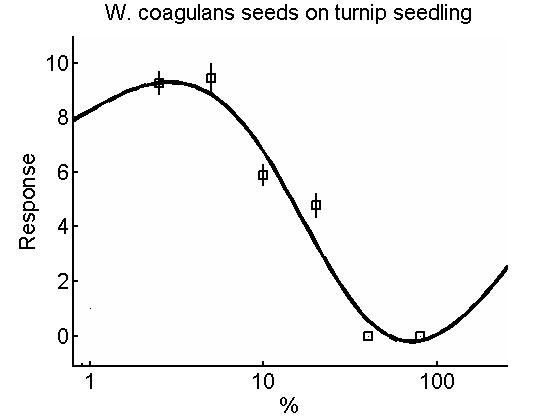
It is apparent that the response for turnip seedling growth and germination peaks at 5% aqueous extract of W. coagulans, which indicates that this is the optimum concentration for stimulating turnip growth and development (Table 2). Furthermore, the response of these seedlings declined sharply as extract concentration increased beyond the optimal concentration. Therefore, higher concentrations are likely inhibitory to turnip health. The response curve depicts a typical hormesis pattern, where low doses stimulate and high doses inhibit turnip growth. In W. coagulans, the phenolic compounds like quercetin (12.32 ppm), ferulic acid (7.48 ppm), gallic acid (1.94 ppm), syringic acid (0.94 ppm), p-coumaric acid (0.94 ppm), and sinapic acid (0.36 ppm) may help it in its allelopathic activity (Table 1). Gallic acid (0.98), Vanillic acid (5.55), P-coumeric acid (0.47), ferulic acid (22.39), and quercetin (2.77) are the phenolic compounds that were present in C. fistula (Table 3). Other phenolic compounds have been reported to exert stimulatory and inhibitory effects on plant growth and development, depending on their concentration and target species.
The 2.5% and 5% aqueous W. coagulans seed extract have the potential to enhance the growth and germination of turnip seedlings and may be recommended for turnip cultivation as a natural growth promoter. Future studies are needed to support the concentration-dependent allelopathic effect of the extract of W. coagulans on turnip seedlings and clarify the mechanism involved in the active constituents that regulate the growth. The practical implication of these findings should be further extended through field trial as a knowledge-based strategy to improve turnip production systems.
Table 1. Phenolic compounds detected in the aqueous extract of W. coagulans
|
Withania coagulans |
||
|
Sr. No. |
Phenolic compounds |
Concentration (ppm) |
|
1 |
Quercetin |
12.32 |
|
2 |
Syringic acid |
0.94 |
|
3 |
Gallic acid |
1.94 |
|
4 |
Sinapic acid |
0.36 |
|
5 |
P-coumaric acid |
0.94 |
|
6 |
Ferulic acid |
7.48 |
Table 2. Allelopathic effects of aqueous extracts from W. coagulans seeds on turnip seedlings
|
Treatments |
Root Length (mm) |
Shoot Length (mm) |
Root fresh weight (mg) |
Shoot fresh weight (mg) |
Mean Emergence Time (MET) |
Germination percentage (%) |
50% Emergence |
|
T1 = 0% (Control) |
17.67 ± 1.2 b |
45.33 ± 2.1 c |
3.67 ± 0.3 c |
12.3 ± 1.0 b |
400.00 ± 15.0 b |
80.0 ± 2.5 a |
3.80 ± 0.2 b |
|
T2 = 2.5% |
25.00 ± 1.5 a |
52.67 ± 2.3 b |
6.33 ± 0.4 a |
18.00 ± 1.2 a |
550.67 ± 20.0 a |
83.3 ± 2.0 a |
5.30 ± 0.3 c |
|
T3 = 5% |
18.67 ± 1.3 b |
56.3 ± 2.5 a |
6.00 ± 0.5 a |
19.67 ± 1.3 a |
570.00 ± 18.0 a |
83.3 ± 2.0 a |
5.36 ± 0.3 a |
|
T4 = 10% |
19.67 ± 1.4 b |
37.67 ± 2.0 d |
5.33 ± 0.4 |
11.67 ± 1.1 b |
380.33 ± 16.0 b |
70.0 ± 3.0 b |
4.06 ± 0.2 b |
|
T5 = 20% |
14.33 ± 1.1 c |
21.67 ± 1.8 e |
2.00 ± 0.2 d |
11.00 ± 1.0 b |
330.00 ± 14.0 c |
10.0 ± 1.5 c |
3.43 ± 0.2 b |
|
T6 = 40% |
0 ± 0 |
0 ± 0 |
0 ± 0 |
0 ± 0 |
0 ± 0 |
0 ± 0 |
0 ± 0 |
|
T7 = 80% |
0 ± 0 |
0 ± 0 |
0 ± 0 |
0 ± 0 |
0 ± 0 |
0 ± 0 |
0 ± 0 |
Means sharing the same letters within a column are not significantly different at the 5% probability level (LSD test).
Table 3. Phenolic compounds detected in the aqueous extract of C. fistula
|
Cassia fistula |
||
|
Sr. No. |
Phenolic compounds |
Concentration (ppm) |
|
1 |
Gallic acid |
0.98 |
|
2 |
Vanillic acid |
5.55 |
|
3 |
P-coumaric acid |
0.47 |
|
4 |
Ferulic acid |
22.39 |
|
5 |
Quercetin |
2.77 |
Table 4. Allelopathic effects of aqueous extracts from C. fistula fruit on turnip seedlings
|
Treatments |
Root length (mm) |
Shoot length (mm) |
Root fresh weight (mg) |
Shoot fresh weight (mg) |
Mean emergence time (MET) |
Germination index |
Germination percentage |
50% Emergence |
|
T1 = 0% (Control) |
14.16 ± 1.1 bc |
29.33 ± 1.5 c |
10.00 ± 0.8 a |
8.00 ± 0.7 c |
6.03 ± 0.5 d |
7.80 ± 0.6 bc |
20.0 ± 1.2 f |
4.80 ± 0.3 cd |
|
T2 = 2.5% |
13.00 ± 1.0 cd |
40.33± 2.0 b |
7.00 ± 0.6 cd |
12.67 ± 1.0 b |
8.53 ± 0.7 bc |
9.43 ± 0.8 a |
33.3 ± 1.5 cd |
6.33 ± 0.4 a |
|
T3 = 5% |
17.33 ± 1.2 a |
39.33 ± 2.1 b |
9.00 ± 0.7 b |
11.67 ± 1.0 b |
8.96 ± 0.8 |
7.03 ± 0.6 c |
37.3 ± 1.6 bc |
5.23 ± 0.3 bcd |
|
T4 = 10% |
13.16 ± 1.1 cd |
38.66 ± 2.0 b |
7.33 ± 0.6 c |
16.67 ± 1.2 a |
8.26 ± 0.7 c |
8.23 ± 0.7 b |
30.0 ± 1.4 de |
5.83 ± 0.3 ab |
|
T5 = 20% |
16.16 ± 1.3 ab |
51.33 ± 2.5 a |
9.83 ± 0.8 ab |
16.67 ± 1.3 a |
8.80 ± 0.8 ab |
9.60 ± 0.9 a |
27.3 ± 1.3 e |
5.50 ± 0.3 abc |
|
T6 = 40% |
11.33 ± 1.0 d |
52.66 ± 2.6 a |
6.33 ± 0.5 d |
18.33 ± 1.4 a |
9.10 ± 0.9 a |
9.20 ± 0.8 a |
40.0 ± 1.8 b |
5.96 ± 0.4 ab |
|
T7 = 80% |
11.66 ± 1.0 d |
39.00 ± 2.0 b |
5.36 ± 0.4 e |
10.67 ± 1.0 b |
8.33 ± 0.7 c |
7.60 ± 0.7 bc |
53.3 ± 2.0 a |
4.33 ± 0.3 d |
Means sharing the same letters within a column are not significantly different at the 5% probability level (LSD test).
3.1 A Potential Hormetic dose Range of W. coagulans on Turnip Germination Index
The relationship between growth inhibition induced by the aqueous extract of W. coagulans and the germination index of turnip was evaluated using the dose-response curve (Fig. 1). The biphasic model provided the best description of the hormetic response of W. coagulans on the germination index of turnip in the dose range of 1-50%, providing a better model than the monophasic models in describing the experimental data. The germination index of turnip showed a slight hormetic stimulatory effect at W. coagulans extract with a concentration lower than 5%, with the mean values marginally higher than the control. However, when the concentration exceeded the threshold of 5%, the growth inhibition was pronounced with a rapid decline in germination index between 10-50% of extract concentration.
The value for half-maximal effective concentration (EC50) was 12.4%, that is, the concentration of the extract at which the germination index was reduced to 50% of the control. This is an easily quantified value that allows a precise description of the extract’s capacity to inhibit the growth of turnip. Most interestingly, the steepness of the curve around the EC50 shows a low range of concentrations between the lowest and highest level of inhibition. At the highest dose tested (100%), which is the concentration of the extract, the germination index was reduced up to 35% of the control, indicating partial inhibition. It seemed that the dose-response curve was flattening out at doses higher than 50% and therefore, the maximum inhibition was attained.
The observed low-dose stimulation and high-dose inhibition, known as hormesis, is supported by evidence from allelopathy and plant ecology literature that points towards the biphasic nature of the effect. These results underscore the complexity of plant-plant interactions and significantly shows that non-monotonic responses should considered while exploring responses to phytotoxicity. W. coagulans is a potent allelopathic species that is negatively affecting cereal crops for centuries. The estimated EC50 and the dose-response relationship could be used to design applications to enhance crop productivity. However, any such future applications must have to contend with the appropriate dose ranges.
Figure 1. Dose-Response Curve of W. coagulants on turnip germination index fitted using a biphasic model (1 inhibitory. + 1 stimulatory.) (X-axis: concentration (%) of aqueous extract of W. coagulans, Y axis: germination index)
Table 5. Biphasic Pharmacodynamic Model Parameters and Model Fit Statistics
|
Parameters |
Biphasic (1 inhibitory + 1 stimulatory) |
|
IC50_1 |
0 |
|
H_1 |
0 |
|
Emax_1 |
0 |
|
IC50_2 |
13.60816 |
|
H_2 |
3.638966 |
|
Emax_2 |
1.5 |
|
IC50_3 |
0.025217 |
|
H_3 |
4.266875 |
|
Emax_3 |
0.414409 |
|
Scaling |
1 |
|
Chi2 |
101.6984 |
|
GOF |
1.08E-13 |
|
aic |
215.3968 |
|
Bic |
347.3968 |
|
EC50 |
12.4 |
The current experiment investigated the allelopathic properties of aqueous extracts from W. coagulans seeds and Cassia fistula fruits on the growth and germination of Brassica rapa (turnip) seedlings. This biphasic pattern of low-dose stimulation and high-dose inhibition is common when other plants interact with plants, but this study represents the first report of such hormetic responses in the context of W. coagulans and C. fistula on turnip the seeds. This hormetic effect is consistent with previous reports showing that some bioactive compounds can either stimulate or inhibit plant growth, depending on concentration levels [5, 6].
The stimulatory actions observed at lower concentrations of W. coagulans extracts, imply the existence of bioactive compounds that regulate plant growth and development. W. coagulans has been found to contain phenolic compounds, including quercetin, ferulic acid, gallic acid, syringic acid, p-coumaric acid, and sinapic acid, known for their allelopathic effects [15, 16]. These volatile organic compounds can also react with plant growth regulators such as auxins and cytokinins, allowing their growth at reduced levels [22]. On the other hand, an increase in concentration of the compounds could have phytotoxic impacts that inhibit growth and germination.
The dual behavior of phenolic compounds in C. fistula extracts may explain the complex nature of the extracts: increasing extract level improved germination, but growth was affected differently. Gallic and vanillic acids are examples of acids capable of fostering germination by impacting dormancy-breaking events and hormonal cues. However, at the same concentrations, these or other compounds can cause phytotoxic stress to seedling development, resulting in relative effects on growth and germination. Phenolic acids like gallic acid, vanillic acid, p-coumaric acid, ferulic acid, and quercetin were found in C. fistula extracts. The compounds were found to stimulate turnip seedlings, resulting in an increase in the shoot length and fresh weight of the seedlings at 20-40% concentrations. Likewise, an additional increase in the germination percentage was observed when the percentage of the compound (80%) was used. These findings suggest that various bioactive compounds in C. fistula fruit extract could have diverse effects on plant growth and development based on the concentration and the target plant species [17]. Practically, W. coagulans seed extract may be used as a natural growth promoter for turnip seeds. W. coagulans extracts at low levels can stimulate the growth of turnip seedlings, increase their quality, and boost crop production. Since, plant-based extracts are less hazardous to the environment than synthetic regulatory substances, they are being investigated more in sustainable agriculture [13].
Quercetin, ferulic acid, gallic acid, and p-coumaric acid are the phenolic compounds found in W. coagulans and C. fistula extracts, which may interact with important plant signaling pathways to regulate growth and germination. For example, flavonoid quercetin has been shown to influence auxin transport and signaling, which are important processes in root growth and cell extension [9, 22]. Hydroxycinnamic acid (ferulic acid) can control the concentrations of reactive oxygen species (ROS) and mitogen-activated protein kinase (MAPK) signaling pathways that mediate responses to plant stress and development [15, 16]. Gallic acid, a phenolic compound, has been reported to induce an interaction with gibberellin and abscisic acid (ABA) pathways as well as affecting seed germination and seed dormancy [17]. In the same way, p-coumaric acid can also influence phenylpropanoid biosynthesis, that is associated with the lignin production and cell wall strengthening, consequently, improving plant growth and stress resistance [8]. Such interactions indicate the phenolic compounds in W. coagulans and C. fistula extracts may be signals that alter hormonal signaling and stress responses to produce the desired hormetic effect on turnip seedlings. Further mechanistic investigations are required to understand the pathways by which these compounds exert their effects and their potential as natural growth regulators in sustainable agriculture.
The results of this research have potential applications in the field of sustainable agriculture. The hormetic response exhibited by turnip seedlings to the W. coagulans seed extract, specifically at low concentrations (2.5% and 5%), indicates that the extract could be utilized as a natural growth promoter in turnip cultivation. To translate such laboratory results into real-world applications, additional research in the future needs to be conducted on field trials under a wider range of environmental conditions, including various soil types, temperatures, and moisture levels [1, 2]. Such trials would be useful in establishing the best application strategies (e.g., foliar spray, soil drench) and timing (e.g., pre-sowing, post-emergence) of W. coagulans extract to maximize growth promotion while minimizing any inhibitory effects of higher concentrations [7, 13]. Moreover, the compatibility of W. coagulans extract with other farm inputs like fertilizers and pesticides, should be studied to determine their effectiveness in integrated crop management systems [2, 14]. Field testing would also help understand the long-term effects of these extracts on the health of soils, microbial communities, and the crop rotation systems [1, 12]. The development of W. coagulans extract may be used commercially to create an environmentally friendly, economically viable, and validated alternative to synthetic growth regulators, which would aid in sustainable crop production and food security [7, 13].
Nevertheless, the allelopathic properties of W. coagulans and C. fistula extracts have not been fully studied, and further studies are needed. More research should be conducted to explain the specific processes through which these extracts influence plant growth. It is recommended that field experiments be carried out to ascertain the growth-promoting effects of the W. coagulans extract under different environmental conditions and to maximize its use of in turnip production systems. Additionally, precipitating and determining the exact phenolic compounds that caused the allelopathic effects would enhance understanding of the plant derived growth regulators, and ensure agricultural sustainability.
This study identifies low-dose (2.5-5%) W. coagulans extracts as potential natural growth promoters of turnip. The efficacy and application protocols of these extracts should be tested in the future by field trials using these extracts as soil drenches or as foliar sprays under diverse environmental conditions. These approaches can serve as alternative to synthetic growth regulators that are environmentally sustainable, and thus promoting sustainable agriculture. However, this study was limited to the laboratory level experiments carried out under controlled conditions that do not fully reflect the dynamics of field performance. In this respect, future studies must focus on long-term field test and the clarification of the particular bioactive components that cause the reported effects.
Acknowledgments
We want to express our gratitude to the University of Agriculture, Faisalabad, Pakistan, for providing the necessary resources and support throughout the preparation of this research paper.
Authors’ Contributions
B.K. contributed data analysis and experimental work, A.A. wrote the manuscript, and R.M., M.A.N., and N.K. designed the experiment and critically revised it.
Funding
This study did not receive any specific grant from funding agencies in the public, commercial, or not-for-profit sectors.
Declarations
Conflict of Interest
The authors declare no conflict of interest.
Data Availability
Not applicable.
Generative AI Statement
The authors confirm that no generative artificial intelligence tools were used in the preparation, analysis, or writing of this manuscript.
REFERENCES